


What if Apple quietly pulled the rug out from under cross-device ads? On April 26, 2021 Apple shipped App Tracking Transparency (ATT), removing default access to the Identifier for Advertisers (IDFA) and breaking deterministic cross-device linking across iPhone, iPad, and tvOS for roughly 75% of users. Advertisers now must rely on first‑party logins, weak probabilistic matches that Apple disallows, or privacy-first systems like SKAdNetwork and Private Click Measurement that return delayed, aggregated reports. This post shows what changed, why it matters to measurement and retargeting, and what to do next.
Core Effects of Apple’s Privacy Update on Cross-Device Tracking

App Tracking Transparency killed deterministic cross-device tracking on April 26, 2021. That’s when Apple shipped iOS 14.5 and yanked default access to the Identifier for Advertisers across iPhone, iPad, and tvOS devices. Unless someone explicitly opts in through that “Ask App not to Track” prompt, apps can’t see the IDFA anymore. Gone is the shared identifier that let advertisers follow one person from their iPhone at breakfast, to their iPad on the couch, to their Mac at the desk. About 75% of iOS users now block cross-app tracking, either by declining the prompt or through automatic blocks on employer-managed devices and kids’ accounts.
Losing IDFA breaks the whole foundation of cross-device identity matching. Before ATT, a marketing platform could spot the same IDFA in a fitness app, a shopping app, and a news app, then connect those sessions to see that one person browsed running shoes on their phone and bought them on their tablet. After ATT, each app sees a different user unless that person logs in with identical account credentials. Advertisers either lean on first-party logins or accept fragmented, incomplete customer journeys across Apple devices.
Apple’s replacement systems, SKAdNetwork for app installs and Private Click Measurement for web clicks, return only aggregated, delayed data with hard caps on detail. SKAdNetwork conversion values use a 6-bit field. That’s 64 possible states, max. Postbacks show up hours or days later to block real-time tracking. The structure deliberately reduces cross-device linking because there’s no persistent user ID and zero device-level detail. You can’t confirm whether a click on an iPad and a purchase on an iPhone came from the same person.
Key limitations ATT introduces:
- Deterministic cross-app linking removed. Without IDFA, you can’t track the same user across apps on one device unless they log in.
- Cross-device attribution accuracy drops. Matching activity between an iPhone and an iPad needs first-party identity or weak probabilistic methods that break App Store rules.
- Attribution windows shortened. Click-through windows shrunk from 28 days to 7. View-through windows cut to 1 day. High-ticket and B2B conversions that happen later just vanish.
- Event measurement capped. You get 8 conversion events per domain. That’s it. Pick carefully.
- Aggregated reporting replaces user-level data. SKAdNetwork and Private Click Measurement spit out campaign stats instead of individual paths, which slows down optimization.
Technical Architecture Behind Apple’s Tracking Restrictions
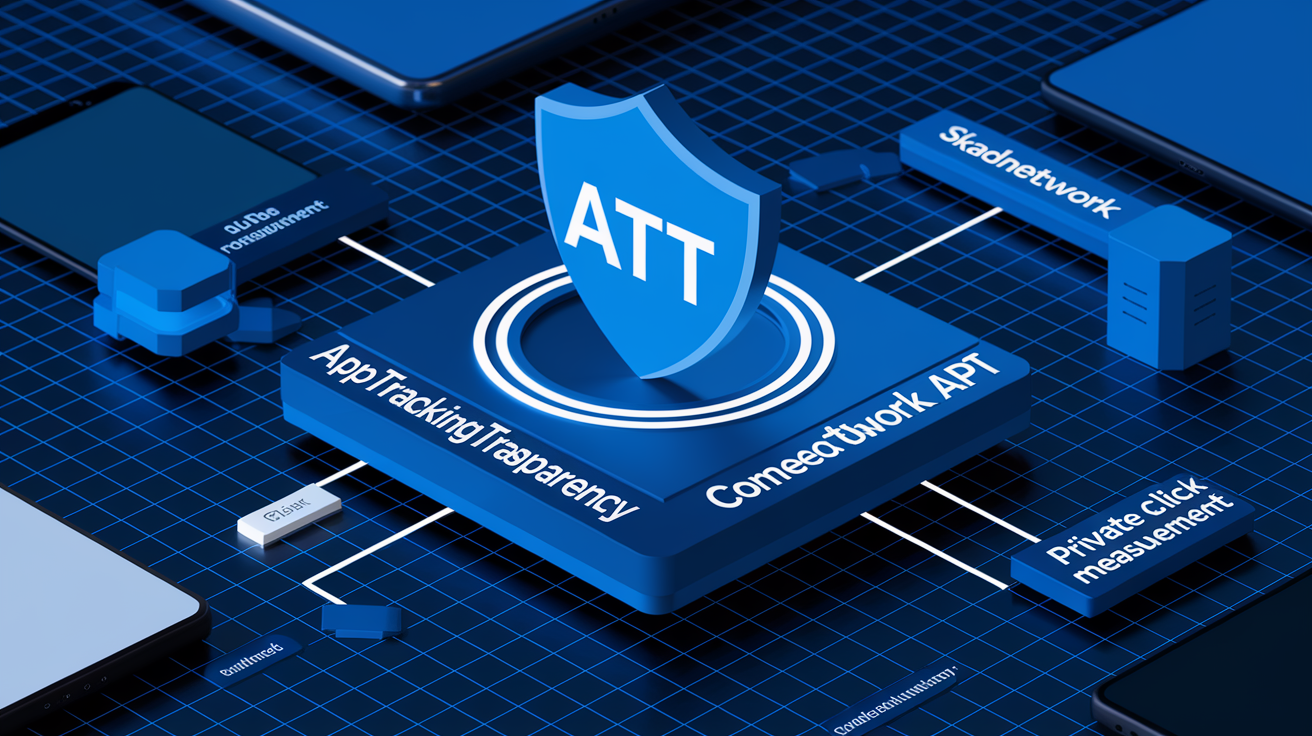
The ATT framework lives at the OS level. It controls access to IDFA through the AppTrackingTransparency API, which returns a permission status: authorized, denied, restricted, or not determined. When someone taps “Ask App not to Track” or the device is auto-restricted, the API hands back an all-zero IDFA (00000000-0000-0000-0000-000000000000). Useless for targeting or attribution. This enforcement happens system-wide, so developers can’t sneak around it by pulling other device properties. Apple explicitly bans fingerprinting and will reject apps that try to build unique IDs from IP addresses, screen resolution, installed fonts, or network config. Apps caught violating these rules risk getting yanked from the App Store, which creates real compliance pressure since Apple controls iOS distribution.
SKAdNetwork and Private Click Measurement swap out direct identifier access for privacy-first attribution flows that separate user identity from conversion signals. SKAdNetwork handles app install attribution by letting ad networks register a click or impression, then waiting for the app to report a conversion value (0 to 63) through Apple’s servers after a randomized delay of 24 to 48 hours. The postback includes the conversion value and campaign ID, but no user ID, no IP address, no timestamp precise enough to re-identify anyone. Private Click Measurement does the same for web attribution, sending delayed conversion reports with the click source and destination but stripping out cookies, referrer headers, and other signals used for cross-site tracking. Apple enforces this in Safari through Intelligent Tracking Prevention and in iOS apps via AppTrackingTransparency policy. It’s layered defense that cuts off both web-based and app-based cross-device profiling.
| Method | Effect on Cross-Device Tracking |
|---|---|
| IDFA API restrictions | Deterministic linking across apps on the same device becomes impossible without user opt-in; cross-device matching via shared advertising identifier removed for ~75% of users. |
| SKAdNetwork / Private Click Measurement | Attribution moves to aggregated, delayed postbacks with no persistent user ID; conversion data limited to 64 values and campaign-level summaries, preventing user-level cross-device joins. |
| Fingerprinting enforcement | Probabilistic cross-device matching (via IP, user-agent, screen size) violates App Store policy and can result in app rejection; reliability drops sharply even when attempted. |
| Device-graph model limitations | Third-party device graphs that previously linked phones, tablets, and desktops via IDFA and IP overlap lose key input signals, reducing accuracy and coverage for advertisers relying on pre-built identity graphs. |
Comparing Pre-ATT vs Post-ATT Tracking Capabilities Across Devices

Before ATT, advertisers routinely built deterministic device graphs linking a user’s iPhone, iPad, and sometimes Mac through consistent advertising IDs, shared IP addresses, and cross-app activity. Someone browsing a product on their phone during a commute, adding it to cart on their tablet at home, and checking out on their laptop could be recognized as one customer across all three touchpoints. Multi-touch attribution worked. Audience profiles stayed unified. Retargeting pools were big and granular because every iOS app interaction came with an IDFA-tagged event. Conversion windows of 28 days for clicks and 7 for views captured delayed purchases typical in travel, finance, and B2B.
After ATT, roughly 75% of iOS users don’t provide IDFA access. That’s explicit opt-outs, devices marked “denied” by prior settings, and restricted devices combined. Cross-device identity fragmented. Advertisers now lean on aggregated models that don’t track individuals. Attribution windows shrunk to 7 days for clicks and 1 day for views, cutting off visibility into longer buying cycles and understating real conversion rates because lots of purchases happen outside the new window. The 8-conversion-event cap per domain means picking which actions matter: page views, add-to-cart, checkout start, purchase, subscription. Mid-funnel insights that fed retargeting and creative tweaks often get sacrificed.
Cross-device attribution accuracy tanked because matching a click on an iPad to a purchase on an iPhone now requires a first-party login (where the user signs in with the same account on both devices) or weak probabilistic signals that Apple’s policies discourage and that don’t perform consistently. Retargeting pools shrank proportionally to the opt-out rate. Advertisers report cart-abandonment and browse-retargeting audiences, previously core revenue drivers for e-commerce, dropped 60% to 75% on iOS. Platforms compensated by broadening targeting and leaning more on algorithmic audience expansion, which lacks the precision of deterministic, user-level segments.
Impacts on Advertisers and Marketers from Apple’s Reduced Cross-Device Visibility

Losing IDFA and shifting to aggregated attribution hit retargeting, frequency capping, and campaign measurement hard. Retargeting pools for iOS users shrank because you can’t build custom audiences from in-app browsing or cross-app activity without explicit opt-in. Cart-abandonment campaigns that used to re-engage users who left items in a mobile shopping app now miss most of those people if they declined tracking. Frequency capping got less reliable. Platforms can’t recognize the same user across apps or devices without a persistent ID, so some users see the same ad too often and budgets get wasted on redundant impressions. Measurement precision eroded. Campaign feedback loops run on delayed, aggregated data from SKAdNetwork and Private Click Measurement, slowing the detection of winning creatives and audiences. Conversions outside the shortened windows often don’t get reported.
ROAS and attribution modeling took the biggest hits, especially for longer sales cycles or higher-ticket products. The compression from 28-day to 7-day click windows excluded conversions that historically happened between day 8 and day 28. Reported conversion rates dropped invisibly. Apparent cost-per-acquisition inflated because the same budget looked like it drove fewer purchases. One major social platform disclosed an estimated $10 billion shortfall in annual ad revenue tied to ATT, with a roughly 26% stock price drop when guidance got revised. The 8-conversion-event limit per domain forced prioritization of high-value actions like purchase or lead submission at the expense of mid-funnel events like product views or email signups. Granularity of optimization dropped. Diagnosing drop-off points in the customer journey got harder.
Industry impacts varied by business model and conversion timeline. E-commerce and mobile-app publishers relying on impulse buys or retargeting saw immediate revenue declines. App developers reported a 14% drop in weekly downloads and a 15% decline in subscription and in-app purchase revenue compared to Android after iOS introduced privacy labels and ATT enforcement. High-ticket and B2B advertisers faced disproportionate pain because their sales cycles often exceed the 7-day click window. A software vendor whose prospects attend a webinar on day 3, download a trial on day 10, and convert to paid on day 20 would see zero attribution for that conversion under the new rules. Those advertisers had to shift to first-party CRM tracking or accept underreported performance.
Apple’s Email and IP Privacy Features That Further Reduce Cross-Device Tracking Reliability

Mail Privacy Protection, introduced in iOS 15, breaks pixel-based open tracking by auto-loading email content and images (including invisible tracking pixels) at message delivery instead of when the user opens it. It also masks the recipient’s IP address and location headers during those loads. Open rates from Apple Mail became unreliable because every message sent to an Apple Mail user registers as “opened” whether the recipient viewed it or not. You can’t infer engagement timing, geographic location from IP, or device type from user-agent strings in pixel requests anymore. Automations that triggered follow-up emails or sales alerts based on open events now fire incorrectly. Pixel techniques like countdown timers or open-time content personalization don’t work for Apple Mail recipients, which represent a big chunk of mobile email opens.
Private Relay, available to iCloud+ subscribers, hides real IP addresses for Safari browsing, DNS resolution, and some app traffic (including insecure HTTP on port 80) by routing connections through Apple-operated proxies that assign anonymous, rotating IPs. When Private Relay is on, IP-based session stitching and fingerprinting fall apart because the same user may show up with different IPs across page views. Or multiple users may share the same proxied IP, breaking the assumption that a consistent IP means one device or household. The “Use Country and Time Zone” option inside Private Relay further degrades geo-targeting by hiding precise location and providing only coarse country-level info. City or region-specific ad campaigns can’t reach the intended audience. Hide My Email, also part of iCloud+, generates unique, random email aliases for each service or signup form. Email-based cross-site tracking gets blocked because you can’t recognize the same person across sites unless they voluntarily provide their real email or log in with a persistent account.
Degraded cross-device signals from iOS 15+ privacy features:
- IP-based matching broken. Private Relay masks real IPs and rotates proxy IPs. You can’t link sessions by IP or infer device location for geo-targeting.
- Pixel-based open tracking unreliable. Mail Privacy Protection auto-loads images at delivery. False “opens” everywhere. User engagement timing, IP, and device metadata all hidden.
- Email stitching blocked. Hide My Email creates unique aliases per signup. Deterministic cross-site matching via email doesn’t work unless the user shares their real address.
- Geo-precision reduced. “Use Country and Time Zone” hides location entirely. City or state-level targeting and analytics that depend on IP geolocation break.
Workarounds and Privacy-Safe Alternatives for Cross-Device Measurement After Apple’s Update

First-party login-based identity is the most reliable method for cross-device tracking after ATT because a user who authenticates with the same account on their iPhone, iPad, and Mac provides a deterministic link that Apple’s privacy restrictions don’t block. Advertisers and publishers are investing heavily in making people want to log in. Loyalty programs, personalized content, exclusive discounts, seamless cross-device experiences that require authentication. Trading value for explicit consent and persistent identity. Hashed email addresses, when collected with clear consent and matched server-side through CRM systems or data clean rooms, enable probabilistic cross-device matching that respects user privacy by keeping raw personal data encrypted and limiting matches to aggregated cohorts instead of individual profiles. Clean rooms, run by platforms or third-party measurement providers, let advertisers join their first-party data with publisher or platform data in privacy-first environments where only aggregated insights and statistical summaries get exposed. Neither party accesses raw user-level information, but attribution and audience analysis still happen.
Server-side tracking, especially Meta’s Conversions API and similar server-to-server event-forwarding systems, recovers conversion events that client-side pixels miss because of ATT restrictions, ad blockers, or browser privacy settings. CAPI sends event data (timestamps, user identifiers, conversion values) directly from the advertiser’s web server or app backend to the ad platform’s API, bypassing the client-side Pixel that relies on cookies and browser scripts. Platforms report that advertisers using CAPI alongside the Pixel see improved data quality scores and higher reported conversion counts because server events can include enriched information (customer email, phone, lifetime value) that improves event matching and attribution accuracy. Cohort-based and aggregated attribution models, like Google’s Privacy Sandbox proposals and Apple’s SKAdNetwork, replace user-level tracking with group-level statistics. Campaign performance gets measured and optimized toward aggregate conversion rates without tracking individual user journeys across devices or apps.
Privacy-safe alternatives for cross-device measurement:
- First-party login and authentication. Get users to create accounts and log in across devices. Deterministic cross-device link with explicit consent and control.
- Hashed email matching. Collect emails transparently, hash them server-side, match against partner or platform hashes in clean rooms. Privacy-preserving audience building and attribution.
- Clean rooms and unified analytics. Use privacy-first data platforms to join advertiser and publisher data at an aggregate level. Attribution without sharing raw user IDs.
- Contextual advertising. Shift budget toward content-based targeting (keywords, topics, page context) that doesn’t rely on user tracking or cross-site identifiers. Less dependence on behavioral signals.
- Server-side event forwarding. Implement server-to-server tracking to capture conversion events missed by client-side pixels. Better attribution completeness and event-match quality.
- Cohort and aggregate models. Adopt privacy-first attribution APIs (SKAdNetwork, Private Click Measurement) and focus on campaign-level metrics and group performance instead of individual user paths.
Future of Cross-Device Tracking Under Apple’s Evolving Privacy Ecosystem

Regulatory momentum is aligning global privacy standards around the principles baked into ATT: explicit consent, data minimization, and user control. GDPR, ePrivacy proposals, and emerging U.S. state laws (California’s CPRA, Virginia’s CDPA) all reinforce opt-in models and restrict opaque cross-device profiling. Apple’s approach, once seen as a competitive move, is becoming the baseline expectation for consumer privacy protections. Platforms that previously resisted similar restrictions are now developing their own consent frameworks and privacy-first attribution systems to stay ahead of regulatory enforcement. Industry watchers expect Apple to keep tightening enforcement of anti-fingerprinting rules, expanding the scope of Private Relay and Hide My Email to cover more traffic types and user groups, and iterating on SKAdNetwork and Private Click Measurement to add more conversion detail and faster reporting without compromising user anonymity.
The rising importance of first-party data and privacy-first modeling reflects a long-term structural shift away from third-party tracking and toward advertiser-owned customer relationships, contextual targeting, and aggregate measurement. Advertisers are rebuilding their data strategies around direct customer interactions: email lists, CRM databases, loyalty programs, mobile app logins. These provide persistent, consented identity without relying on platform-controlled IDs like IDFA or third-party cookies. Privacy-first measurement techniques, including differential privacy, federated learning, and clean-room analytics, are maturing fast and will likely become standard tools for attribution and audience insights as platforms and regulators both push the industry toward methods that deliver business value without exposing individual user behavior.
Final Words
ATT removed the IDFA on iPhone, iPad, and Mac with iOS 14.5 on April 26, 2021, undermining deterministic cross-device linking.
Mail Privacy, Private Relay, and Safari ITP have chipped away at other signals; SKAdNetwork and PCM now return aggregated, delayed results, so identity matching and retargeting are less reliable.
How Apple’s privacy update affects cross-device tracking: it pushes teams away from device-level joins toward first-party IDs, server-side measurement, clean rooms, and contextual methods. It’s tougher short-term, but measurement can become more robust and more respectful of user privacy.
FAQ
Q: How do I tell if my iPhone is being monitored?
A: You can tell if your iPhone is being monitored by watching for sudden battery or data spikes, unknown apps or profiles, unexpected pop-ups, and by checking Settings → Privacy → Tracking and General → VPN & Device Management.
Q: How to prevent cross-app tracking on iPhone? / How to prevent cross site tracking on iOS?
A: To prevent cross-app and cross-site tracking on iPhone/iOS, disable “Allow Apps to Request to Track,” enable Safari’s “Prevent Cross‑Site Tracking,” use Mail Privacy Protection and Private Relay, and limit app permissions.
Q: Should I turn off privacy preserving ad measurement on my iPhone?
A: You should turn off privacy-preserving ad measurement on your iPhone only if you need user-level ad metrics; keeping it on preserves aggregated campaign reporting while protecting user identities and reducing cross-device linking.