


What if your ad targeting engine stopped working overnight?
That’s the practical threat from Apple’s privacy changes — IDFA (Apple’s device ID), open tracking, and client‑level signals are being locked down, and publishers feel the impact now.
To keep ads and measurement intact you need to rebuild the basics: capture first‑party users, shift to contextual ads, update app SDKs and plist settings, and run server‑side analytics for aggregated measurement.
Do that, and you can stabilize revenue while you diversify into subscriptions, sponsorships, and direct deals.
Core Adaptation Strategies for Apple’s Privacy Policy Changes

Publishers need to rebuild four operational foundations right now: capture first‑party data through registration and authenticated sessions, switch to contextual advertising instead of behavioral targeting, update SDKs and app configs to match Apple’s privacy rules, and set up privacy‑compliant analytics pipelines. These aren’t nice‑to‑haves. They’re required to keep ad revenue and measurement working when IDFA, open tracking, and IP geolocation disappear by default. The shift touches email segmentation, mobile app monetization, and programmatic yield across every category, from news to lifestyle to finance.
Restructuring monetization under Apple’s privacy constraints means treating targeted ad inventory as one channel instead of the main revenue driver. Publishers who built entire business models around granular audience segments and retargeting loops now have to balance programmatic with subscriptions, native sponsorships, direct‑sold contextual deals, events, commerce integrations, and membership programs. The economics are simple: when conversion values stay low or null for weeks, demand‑side algorithms cut bids and move budgets to inventory with better signals. Diversification gives you a shorter path to stable revenue when CPMs drop.
Six actions to take now:
Instrument first‑party registration and progressive profiling so you’re capturing more authenticated, consented users and relying less on third‑party identifiers.
Pilot contextual advertising tools that pull semantic, keyword, and page‑level signals to keep targeting relevant without tracking individual behavior.
Update Info.plist, SDK versions, and domain whitelists so ad delivery, attribution postbacks, and web requests actually work under Apple’s technical requirements.
Deploy server‑side event pipelines and aggregated measurement to replace client‑side scripts that can’t capture open rates, device IDs, or IP addresses anymore.
Launch or expand subscription offerings with tiered access, paywalls, and exclusive content to stabilize revenue independent of programmatic swings.
Audit and minimize third‑party tags to reduce consent friction, improve page speed, and align data collection with Apple’s self‑reporting and privacy label expectations.
Technical Foundations for Publishers Under Apple’s Privacy Changes

SKAdNetwork gives you privacy‑first attribution for iOS app installs by encoding post‑install behavior into conversion values from 0 to 63. Ad networks register ads with Apple. When a user installs the app, the app updates a single conversion value during a measurement window. Apple then sends an anonymized, randomly delayed postback to the ad network. The postback contains the conversion value, the source app identifier, and campaign metadata, but no device ID, timestamp, or user‑level data. If install volume falls below Apple’s threshold for a given campaign or source, SKAN may cancel the postback entirely or deliver a coarse signal (low, medium, high) instead of a precise 0–63 value. This coarsening protects privacy but cuts the granularity advertisers use to optimize bids and budget allocation.
Server‑side tracking infrastructure and cohort‑based analytics fill the gaps SKAN can’t address. Because SKAN postbacks are delayed and anonymized, you’ve got to build event pipelines that aggregate conversions, registrations, purchases, and engagement metrics on the server instead of relying on client‑side pixels. Cohort reporting groups users by install date, source app, or campaign and measures aggregated outcomes. That preserves statistical power for decision‑making while respecting Apple’s anonymization design. Conversion APIs, data clean rooms, and modeled attribution frameworks offer alternative measurement paths when deterministic, user‑level attribution isn’t available.
Four technical priorities to implement right away:
Add SKAdNetworkItems to Info.plist with the complete list of ad network IDs used by your mediation partners and demand sources. Missing IDs block attribution postbacks.
Whitelist ad‑serving domains in WKAppBoundDomains if your app uses App‑Bound Domains. Unwhitelisted domains will cause web view requests to fail and prevent ad creative from loading.
Design conversion‑value schemas that map your most important post‑install events (registration, first purchase, day‑3 retention, content unlock) to the 0–63 value space. Unclear schemas produce noisy signals that reduce advertiser confidence.
Instrument server logging to capture SKAN postbacks and coarse signals so analytics teams can correlate source‑app performance, conversion distributions, and install thresholds with bid behavior and eCPM trends.
First‑Party Data Collection and Authenticated User Experiences Under Apple’s Rules

You’ve got to treat authenticated user experiences as the core signal layer when third‑party identifiers disappear. Registration walls, progressive profiling, and value‑exchange incentives increase the share of logged‑in traffic and consented email addresses. Those signals persist across sessions, devices, and privacy updates. Apple Mail Privacy Protection blocks open tracking by masking when emails are opened and hiding IP addresses, which kills open‑rate‑based segmentation and location inference. Without authenticated behavior, you lose the ability to tell active subscribers from dormant ones, to trigger re‑engagement sequences, or to measure campaign performance beyond raw click‑throughs. A registration system that captures name, email, preferences, and opt‑in consent restores those capabilities under privacy‑compliant terms.
Practical incentives for consent preserve user experience while raising data quality. Offer exclusive newsletters, early access to events, discount codes, saved preferences, or ad‑free tiers in exchange for registration. Progressive profiling (asking one or two fields per visit instead of a ten‑field form) reduces abandonment and builds profiles over time. Transparency about data use improves completion rates. Users who understand that consent unlocks personalized content, better recommendations, or faster checkout are more likely to share information. Consent management platforms must integrate App Tracking Transparency (ATT) states, display clear privacy labels, and provide simple opt‑out controls to meet Apple’s self‑reporting requirements and avoid App Store enforcement.
CRM workflows evolve by shifting segmentation from open‑based triggers to click, web behavior, purchase history, and authenticated session data. Instead of “last opened 7 days ago,” use “clicked link in last 14 days” or “visited three articles this month.” Instead of time‑zone inference from IP, ask for location preferences during onboarding. Instead of A/B tests on subject lines measured by open rate, measure click‑through rate, downstream page views, subscription conversions, or revenue per recipient. These changes require rethinking automation logic, updating segment definitions, and retraining teams to interpret metrics that reflect intentional user actions rather than passive signals like email client pre‑fetching.
Five first‑party data actions:
Launch lightweight registration gates on high‑traffic pages with single‑field email capture and a clear value proposition.
Implement progressive profiling that collects interests, content preferences, and demographic data across multiple sessions.
Integrate ATT consent states into your consent management platform and display privacy labels that accurately reflect data collection.
Build authenticated paywalls and membership tiers that reward registration with exclusive content, saved articles, or ad‑light experiences.
Migrate email segmentation and automation triggers from open‑based logic to click, web visit, purchase, and session‑based signals.
Contextual Advertising and Creative Optimization Without Identifiers

Contextual advertising replaces user‑level behavioral tracking with content‑level semantic analysis, extracting targeting signals from the page, article, video, or app screen where the ad appears instead of from the user’s browsing history. Contextual platforms analyze keywords, categories, entities, sentiment, and topic clusters in real time to match ad creative to editorial context. A finance article surfaces investment ads. A travel guide shows hotel promotions. A recipe post delivers grocery sponsorships. The match relies on content understanding, not cookies or device IDs, which makes contextual targeting resilient to ATT, IDFA deprecation, Mail Privacy Protection, and future browser changes. Publishers who instrument semantic metadata (tags, categories, author expertise, entity graphs) unlock higher CPMs by offering advertisers precise, brand‑safe, privacy‑compliant inventory.
Creative optimization under contextual models shifts from retargeting and lookalike audiences to message testing, headline variations, visual relevance, and alignment with content tone. Advertisers can’t follow users across apps, so campaign performance depends on immediate relevance: does the ad’s headline echo the article’s theme? Does the creative’s visual style match the publisher’s design language? Does the offer solve a problem the reader is actively exploring? Publishers who provide rich contextual signals (reading time, scroll depth, engagement clusters, topical intensity) enable advertisers to refine bids and creative without tracking individuals. This signal quality directly impacts yield. Contextual inventory backed by clean metadata commands premium rates compared to generic “news” or “entertainment” categories.
| Contextual Method | Typical Use Case |
|---|---|
| Keyword and category matching | Aligning auto ads with car reviews, home goods with interior design articles |
| Semantic content analysis | Extracting entities (brands, locations, products) and sentiment to match ad tone |
| Page‑level engagement signals | Surfacing high‑engagement articles to premium sponsors seeking quality placements |
Subscription Growth and Revenue Diversification After Privacy Shifts

Privacy‑driven CPM compression makes subscriptions, memberships, and owned‑revenue channels essential instead of optional. When conversion values stay low or coarse, demand‑side algorithms cut bid rates and shift budgets to inventory with better signals, which lowers programmatic yield for publishers who rely exclusively on ad‑supported models. Subscription revenue (whether metered paywalls, freemium tiers, premium newsletters, or membership clubs) provides predictable income independent of third‑party cookie deprecation, IDFA availability, or email open tracking. Publishers who capture even 5–10% of monthly visitors as paying members create a revenue floor that stabilizes operations when ad markets tighten.
Diversification beyond subscriptions includes native sponsored content, affiliate commerce, virtual and in‑person events, licensing and syndication deals, and community‑driven membership perks. Native sponsorships align with contextual advertising principles. Advertisers pay for editorial integration, brand mentions, and content collaboration instead of behavioral targeting. Affiliate revenue from product recommendations, shopping guides, and comparison articles generates commissions without relying on retargeting pixels. Events (webinars, conferences, workshops, online courses) monetize audience expertise and engagement directly. Each channel reduces dependence on programmatic impressions and mitigates the revenue volatility introduced by Apple’s privacy policies and low SKAN conversion values.
Premium content gating and tiered packages optimize subscription growth by offering multiple entry points. A metered paywall (five free articles per month) converts casual readers. A newsletter‑only tier ($5/month) attracts email‑first audiences. A premium all‑access bundle ($15/month) serves power users. Dynamic paywalls that adjust based on content type, user behavior, or referral source increase conversion rates without alienating free users. Loyalty programs (points for engagement, discounts for annual commitments, exclusive community access) improve retention and lifetime value. These strategies work best when paired with first‑party data. Knowing a user’s content preferences, visit frequency, and engagement history lets you deliver personalized offers that drive higher take rates than generic subscription prompts.
Four revenue diversification examples:
Metered paywalls and freemium tiers that convert 3–8% of monthly visitors into paying subscribers, creating a stable revenue base.
Native sponsored content and contextual partnerships where advertisers pay for editorial integration, brand storytelling, and topic sponsorships.
Affiliate commerce and product recommendation programs that earn commissions on purchases driven by shopping guides, reviews, and curated lists.
Virtual events, webinars, and premium community memberships that monetize expertise, networking, and exclusive access beyond display advertising.
Compliance, Consent, and Apple‑Aligned Privacy Governance

Apple requires developers to self‑report the types of data their apps collect and to display accurate privacy labels in the App Store. These labels must reflect actual data usage, including data accessed by third‑party SDKs, ad networks, and analytics providers embedded in the app. Misleading or incomplete labels trigger App Store enforcement, user complaints, and potential removal. You’ve got to audit every SDK, tag, and third‑party integration to document what data each component collects (location, contacts, browsing history, purchase data, identifiers), how it’s used (analytics, advertising, functionality), and whether it’s linked to user identity. This audit feeds both the App Store privacy label and internal data governance policies.
Consent management platforms (CMPs) govern App Tracking Transparency (ATT) prompts and coordinate consent states across analytics, advertising, and attribution frameworks. ATT prompts must appear before accessing IDFA, and the prompt’s messaging must clearly explain why tracking permission is being requested. SKAdNetwork and server‑side measurement still function when users decline ATT, but deterministic cross‑app tracking and retargeting don’t. CMPs also manage email consent, cookie consent (where applicable), and regional privacy laws (GDPR, CCPA), ensuring that data collection aligns with user choices. Publishers who fail to implement CMPs correctly risk blocked ad requests, attribution gaps, and regulatory penalties.
Transparent privacy policies and user‑facing controls build trust and reduce opt‑out friction. Privacy policies should use plain language to explain what data is collected, why it’s needed, who it’s shared with, and how users can access, delete, or export their information. In‑app settings should allow users to toggle tracking, clear stored data, and manage email preferences without contacting support. Transparency reduces the perception that publishers are hiding data practices, which improves consent rates and long‑term user retention. When users understand the value exchange (consent enables personalized content, saved preferences, and ad‑supported free access), they’re more likely to grant permission than when presented with vague, legalistic prompts.
Three compliance priorities:
Audit and update App Store privacy labels to accurately reflect all data collection by first‑ and third‑party SDKs, including ad networks and analytics providers.
Implement a consent management platform that handles ATT prompts, email consent, and regional privacy regulations with clear, user‑friendly messaging.
Publish transparent privacy policies and in‑app data controls that explain data use in plain language and allow users to manage permissions without friction.
Implementing SKAdNetwork 4.0 and AdAttributionKit for Publishers
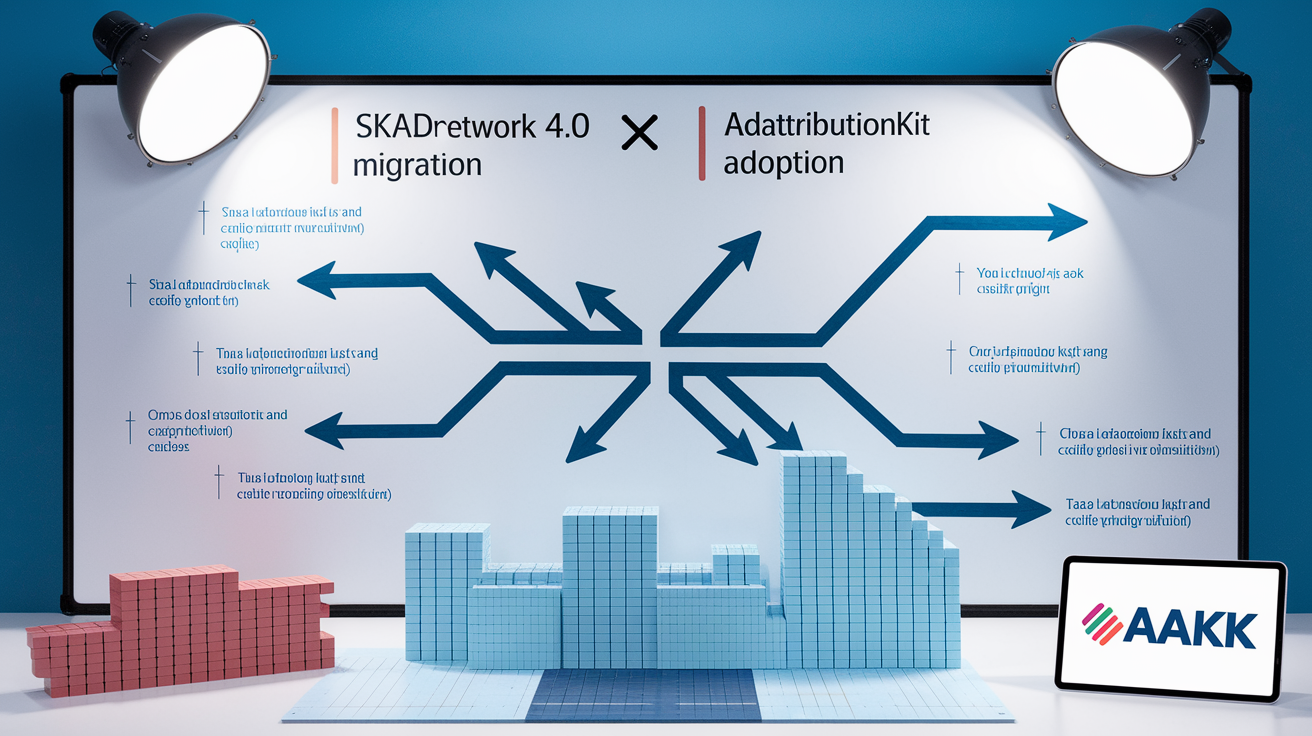
Publishers running iOS apps must update Info.plist to include the SKAdNetworkItems array populated with every ad network ID used by mediation partners, direct integrations, and demand sources. Missing IDs prevent attribution postbacks from reaching the ad network, which breaks campaign measurement and reduces advertiser confidence. Each network provides its SKAdNetwork identifier. Publishers aggregate these into a single array and validate the configuration before release. WKAppBoundDomains (used when apps restrict web view access to approved domains) must whitelist all ad‑serving, tracking, and creative‑hosting domains required by ad SDKs. Unwhitelisted domains cause web view requests to fail silently, blocking ad creative from loading and generating user complaints about blank ad slots.
Ad network registration is the network’s responsibility, but you should confirm that partners have completed Apple’s registration process and provided current identifiers. Mediation platforms typically publish updated ID lists. Smaller networks may require direct outreach. SKAN 4.0 introduced hierarchical source identifiers and coarse conversion values, which improve privacy but complicate event schema design. You’ve got to map post‑install actions (registration, purchase, day‑3 retention, content unlock) to the 0–63 conversion‑value range in ways that preserve signal quality while respecting user anonymity. Clear schema documentation helps demand partners interpret conversion distributions and adjust bids appropriately.
Transitioning from SKAN 4.0 to AdAttributionKit
Apple announced AdAttributionKit (AAK) as the successor to SKAdNetwork, with phased adoption beginning in November 2025. AAK introduces new APIs, updated postback structures, and expanded measurement capabilities, but SKAN 4.0 remains functional and widely supported. You should implement both frameworks concurrently during the transition, updating SDKs to support AAK while maintaining SKAN 4.0 compatibility for partners who haven’t migrated yet. Monitor vendor‑specific adoption schedules. Major mediation platforms, DSPs, and MMPs will publish AAK support timelines over the coming months. Dual‑framework operation ensures continuity of measurement and attribution during the migration window without disrupting live campaigns. SKAdNetwork news article provides updated guidance on AAK rollout timelines and technical requirements.
SDK updates must be tested in staging environments before production release to catch configuration errors, missing network IDs, or domain whitelist gaps. Coordinate updates with ad ops, engineering, and analytics teams to validate that postbacks are logging correctly, conversion values are populating as expected, and coarse signals are being captured for low‑volume campaigns. Publishers who skip staging risk silent attribution failures that only become visible when advertiser reports show missing data weeks later.
Measurement Alternatives and Privacy‑Safe Attribution Models

Anonymized, delayed, and coarse SKAdNetwork signals can’t support real‑time optimization or user‑level attribution, which creates demand for privacy‑aligned measurement alternatives. Cohort‑based analytics group users by shared characteristics (install date, source app, campaign, geographic region) and measure aggregated outcomes such as retention rate, average revenue per user, or conversion rate. Cohort reporting preserves statistical power for decision‑making while respecting Apple’s anonymization design. You instrument cohort pipelines by tagging installs with source metadata, bucketing users into time‑based or behavior‑based cohorts, and tracking aggregated metrics over 7‑, 14‑, and 30‑day windows.
Incrementality testing measures the causal impact of ad spend by comparing outcomes between exposed and control groups. Instead of attributing every install to the last ad click, incrementality tests answer whether the campaign drove more installs than would have occurred organically. Publishers and advertisers run controlled experiments (holding out a percentage of inventory or geo‑targeting specific regions) and measure the lift in conversions, registrations, or revenue. Incrementality complements SKAN by validating whether attribution signals correlate with real performance instead of selection bias or natural user behavior.
Modeled attribution uses statistical techniques (regression, machine learning, survival analysis) to estimate source contribution when deterministic tracking isn’t available. Models ingest aggregated event data, campaign metadata, conversion signals, and external variables (seasonality, competitor activity, market trends) to probabilistically assign credit across channels. Modeled attribution introduces uncertainty but offers directional insight when privacy policies block user‑level tracking. Publishers who adopt modeled approaches must validate assumptions, test model accuracy against known outcomes, and communicate confidence intervals to stakeholders to avoid over‑interpreting noisy estimates.
Event aggregation pipelines collect and summarize conversion events on the server before sending them to analytics platforms, reducing reliance on client‑side scripts that privacy tools block. Server‑to‑server integrations bypass browser extensions, email privacy proxies, and ATT restrictions, capturing purchase confirmations, registration completions, and subscription activations directly from backend systems. Aggregated events are anonymized and batched to protect individual privacy while preserving volume metrics, conversion rates, and revenue totals for campaign analysis.
Four privacy‑safe measurement alternatives:
Cohort‑based analytics that group users by install date, source, or campaign and measure aggregated retention, revenue, and engagement metrics.
Incrementality testing using controlled experiments to measure the causal lift of ad spend compared to organic baseline performance.
Modeled attribution that applies statistical techniques to estimate source contribution when deterministic tracking is blocked by privacy policies.
Server‑side event aggregation that captures conversion confirmations, registrations, and purchases directly from backend systems without client‑side pixels.
Case‑Style Examples of Publisher Adaptation in a Post‑ATT World

A regional news publisher with 45% Apple Mail users observed inflated open rates after Mail Privacy Protection launched, making it impossible to tell engaged subscribers from inactive ones. The publisher audited email automations, disabled all open‑based triggers, and rebuilt segmentation using click‑throughs, article page views, and authenticated session data. At the same time, the team launched an eight‑week contextual advertising pilot with three mid‑market sponsors, replacing behaviorally targeted display inventory with content‑aligned native placements and keyword‑matched banners. Within three months, campaign performance stabilized, advertiser confidence recovered, and email engagement metrics became reliable again by focusing on intentional user actions instead of proxy signals.
A niche newsletter publisher serving 30,000 subscribers (30% on Apple Mail) faced declining ad revenue as open rates became unreliable and programmatic CPMs compressed. The publisher introduced a lightweight registration gate that captured email, name, and two content preferences in exchange for access to premium newsletters and saved article features. Over four months, the share of logged‑in users rose from 22% to 55%. The team then launched a two‑tier subscription model ($5/month for newsletter‑only access, $12/month for all‑access plus events) and moved top advertisers to contextual sponsorships and native content partnerships. The diversified revenue mix reduced dependence on open‑rate metrics and created a predictable income stream independent of third‑party tracking changes.
| Challenge | Outcome |
|---|---|
| Regional publisher: 45% Apple Mail users, unreliable open rates, broken segmentation | Switched to click‑based triggers, piloted contextual ads, stabilized performance in 3 months |
| Newsletter publisher: declining CPMs, 30% Apple Mail, no first‑party data capture | Raised logged‑in share to 55%, launched two‑tier subscription, diversified revenue with native sponsorships |
Final Words
First-party data, contextual targeting, timely SDK updates, and privacy-compliant analytics are the immediate moves publishers should make.
Restructure monetization toward subscriptions, native partnerships, and diversified demand while keeping CMPs and governance tight.
How publishers can adapt to Apple’s privacy policy changes: prioritize authenticated users, privacy-safe measurement, and contextual creative, then run short experiments to prove value. Keep CMPs updated, diversify revenue, and measure with cohorts. It’s doable and increasingly profitable.
FAQ
Q: Does Apple have a good privacy policy?
A: Apple’s privacy policy emphasizes strong user controls, transparency, and opt‑in tracking (ATT) plus Mail Privacy Protection; it’s robust compared with many peers, though implementation and ecosystem tradeoffs challenge publishers and advertisers.
Q: When did Apple change its privacy settings?
A: Apple changed major privacy settings beginning with App Tracking Transparency (ATT) in 2021 and Mail Privacy Protection in iOS 15 (2021); further shifts include SKAN updates and AdAttributionKit rollout starting November 2025.
Q: Is that iPhone app spying Apple’s app privacy report revealing all?
A: The iPhone App Privacy Report reveals app network calls, sensor and data access, and on‑device trackers, but it doesn’t show all backend tracking, ad measurement methods, or off‑device data matching by some networks.
Q: What is the Apple data privacy scandal?
A: The Apple data privacy scandal refers to incidents where Apple’s privacy promises were questioned—examples include Siri audio grading, disputed privacy labels, or enforcement gaps; specifics depend on the particular report or investigation.