


Think Apple surprises developers with privacy rules? Not really.
Their privacy changes follow a predictable cycle around WWDC, developer and public betas, then a fall release.
This timeline lays out the key rollout dates — from Privacy Nutrition Labels and ATT to link-tracking removal and the Privacy Manifest — and shows when enforcement dates typically follow.
If you build apps, run marketing, or manage compliance, use this guide to plan work, update SDKs, and avoid last-minute rejections.
Bottom line: timing matters.
Apple Privacy Update Timeline (Quick Overview)

Apple’s privacy changes arrive in predictable waves, each tied to its annual OS cycle. If you’re a developer, marketer, or compliance lead, knowing the exact dates means you can actually prepare instead of scrambling.
Key rollout dates:
- December 8, 2020 – Privacy Nutrition Labels went live. Every App Store submission after this date needed one.
- April 26, 2021 – App Tracking Transparency (ATT) enforcement started with iOS 14.5. No prompt, no IDFA access.
- September 20, 2021 – Mail Privacy Protection dropped with iOS 15, killing email pixel tracking.
- September 12, 2022 – Safari got stronger fingerprinting defenses in iOS 16.
- September 18, 2023 – Link tracking removal spread across Safari, Mail, and Messages in iOS 17.
- January 24, 2024 – Privacy Manifest requirement announced. Enforcement hit in May 2024.
Apple usually announces privacy stuff at WWDC in early June, ships developer betas within a day, and public betas follow in July. Stable releases land mid-September. But enforcement? That’s often weeks or months later, giving devs time to catch up.
Most features aren’t mandatory until Apple sets a hard deadline. ATT was announced in June 2020, originally planned for September, then delayed to April 2021. This phased approach gives everyone breathing room. Once the enforcement date is set though, it’s firm.
Major Milestones in Apple’s Privacy Policy Evolution

Apple started clamping down in 2017 with Safari’s Intelligent Tracking Prevention (ITP), which went after cross-site cookies. ITP 1.0 shipped with Safari 12 and iOS 11 in June 2017. That was the beginning of systematic third-party tracking restrictions. Through 2018 and 2019, Apple iterated fast. ITP 1.1 came in March 2018 with iOS 11.3. Then ITP 2.0 in June 2018, 2.1 in February 2019, and 2.2 and 2.3 later that year. Each update shortened cookie lifespans and closed loopholes advertisers kept finding.
In 2020, Apple shifted from browser tweaks to platform-wide policy. At WWDC in June 2020, they announced plans to require explicit consent for app tracking, introducing the App Tracking Transparency framework. Enforcement got pushed from September 2020 to early 2021. iOS 14.5 launched ATT on April 26, 2021. At the same time, Privacy Nutrition Labels became mandatory in December 2020 with iOS 14.3, forcing developers to disclose data collection before users even downloaded an app.
iOS 15, released September 20, 2021, took privacy beyond advertising. Mail Privacy Protection blocked email tracking pixels by preloading content through proxy servers. Hide My Email let users spin up disposable email addresses. iCloud+ introduced Private Relay, routing Safari traffic through two separate servers to hide IP addresses and browsing activity from both Apple and third parties.
The 2023–2024 stretch focused on cutting tracking across communication apps and tightening SDK transparency. Safari in iOS 17 (September 2023) started stripping tracking parameters from URLs in Messages and Mail. It locked private browsing tabs with Face ID and disabled extensions by default in private mode. In May 2024, Apple required all apps to include a Privacy Manifest file detailing SDK usage and data collection. Enforcement started immediately for new submissions.
| Year | Feature | OS Version |
|---|---|---|
| 2017 | Intelligent Tracking Prevention 1.0 | iOS 11 / Safari 12 |
| 2020 | Privacy Nutrition Labels | iOS 14.3 |
| 2021 | App Tracking Transparency (ATT) | iOS 14.5 |
| 2021 | Mail Privacy Protection | iOS 15 |
| 2023 | Link Tracking Removal | iOS 17 |
| 2024 | Privacy Manifest Requirement | App Store Policy |
Phased Rollout Structure for Apple Privacy Updates
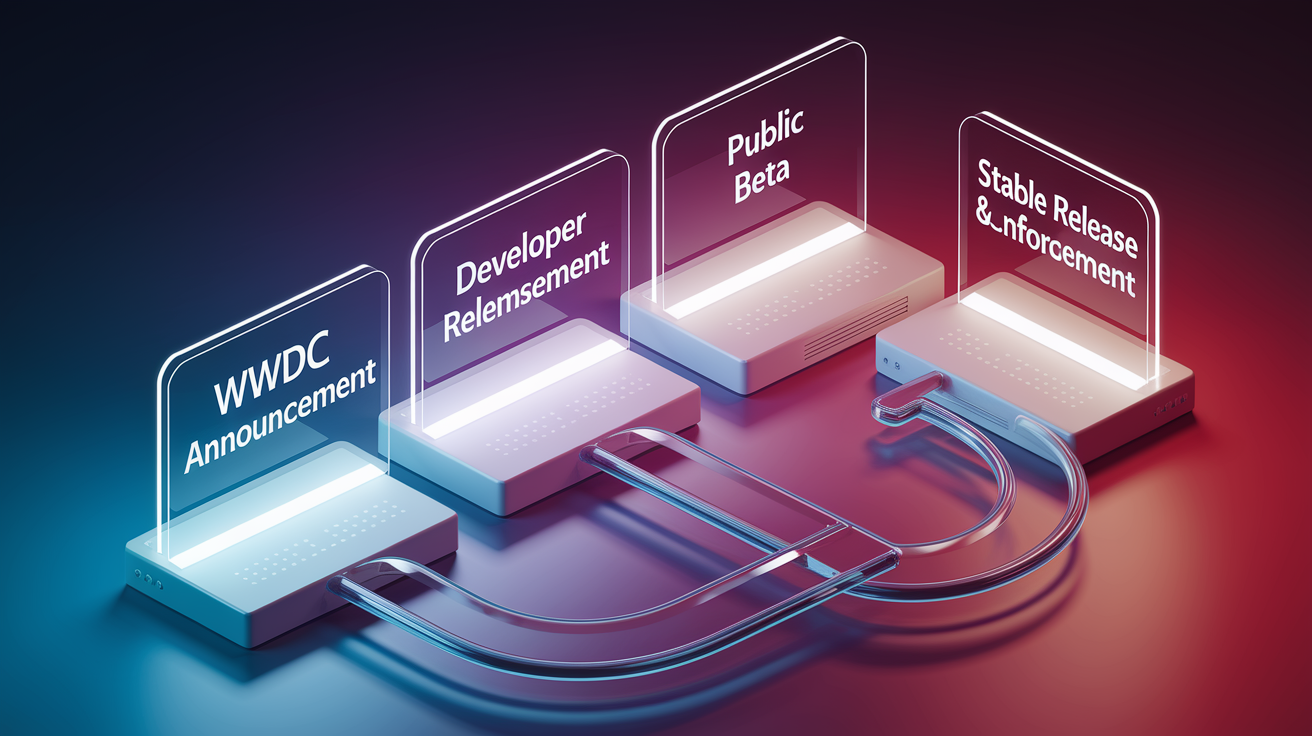
Apple runs a four-stage release process for privacy features, synced to its annual OS cycle. It kicks off in June and wraps in September, though enforcement deadlines often come later.
Privacy rollouts mirror the broader iOS development schedule. Changes announced at WWDC become available to registered developers immediately through beta builds. By mid-summer, Apple opens testing to the public. Final releases ship in the fall. But mandatory compliance dates land weeks or months afterward to give developers time to adapt.
The four rollout phases:
-
WWDC announcement – Apple introduces new privacy features in June keynotes and breakout sessions, with technical docs and sample code.
-
Developer beta – Within 24 hours, registered developers get beta builds to test changes and update apps.
-
Public beta – About a month later, Apple releases public betas to millions of testers, surfacing edge cases and compatibility issues.
-
Stable release and enforcement – The final OS version ships in September. Policy enforcement typically begins 30–180 days later, once Apple sets a firm compliance deadline.
Compliance Deadlines for Developers

Missing an Apple privacy compliance deadline can get your app rejected, updates delayed, or pulled from the App Store. Apple enforces these dates strictly once they’re announced, so early prep is critical.
Apple typically sets enforcement windows 90 to 180 days after a feature’s stable OS release. This buffer lets dev teams audit codebases, update SDKs, and submit revised apps for review. But Apple doesn’t always give advance warning for minor policy updates, especially when closing known workarounds or patching security holes. Teams that watch WWDC sessions and developer release notes get the most lead time.
Three major compliance deadlines show the pattern. December 8, 2020 was the mandatory start date for Privacy Nutrition Labels. Any app submitted after that without completed privacy disclosures got rejected during review. April 26, 2021 brought App Tracking Transparency enforcement. Apps accessing the device advertising identifier (IDFA) without showing the ATT prompt were automatically rejected. May 1, 2024 set the deadline for Privacy Manifest files. All new apps and updates submitted after this date needed a manifest detailing third-party SDKs and data collection practices. Non-compliant submissions were returned without review.
Impact of Apple’s Privacy Timeline on Businesses and Advertising

App Tracking Transparency changed ad attribution overnight when it launched in April 2021. Within weeks, roughly 95% of U.S. users opted out of tracking, eliminating IDFA access for most advertisers. Marketing teams that relied on deterministic user-level attribution lost the ability to tie ad impressions to app installs or purchases. The shift forced rapid adoption of SKAdNetwork, Apple’s privacy-preserving attribution framework, and pushed advertisers toward modeled attribution and aggregated reporting. Many companies reported 30–60 day adaptation periods to rebuild measurement infrastructure.
iOS 15’s Mail Privacy Protection wrecked email marketing metrics starting in September 2021. Because Apple preloaded email content through proxy servers, open rates became unreliable overnight. Marketers lost the ability to track when recipients opened emails or use IP-based geolocation. Engagement strategies that triggered follow-up campaigns based on open behavior broke. Email platforms adapted by emphasizing click-through rates and conversion events instead. But the transition required rewriting automation rules and recalibrating performance benchmarks.
Businesses typically need 30 to 90 days to adapt after each major privacy rollout. That window includes technical implementation, QA testing, and user communication. Companies that start planning at the developer beta stage gain a real operational advantage and avoid last-minute scrambles before enforcement deadlines.
Anticipated Future Privacy Rollout Patterns

Apple will almost certainly keep its annual June-to-September privacy expansion cycle going. Based on the past five years, the next wave of restrictions will probably show up at WWDC 2026 (early June), enter developer beta the same week, reach public beta in July, and ship with iOS 27 in mid-September. Enforcement deadlines for any new requirements would follow 90–180 days later, putting compliance dates between December 2026 and March 2027.
Future privacy changes will likely address on-device AI processing, stricter API governance, and cross-app data sharing. Apple’s already signaled interest in keeping personal data processing local through features like on-device Apple Intelligence introduced in iOS 26. Expect tighter controls around when apps can access photos, contacts, location, and health data, plus expanded disclosure requirements for any data leaving the device. Browser fingerprinting defenses will keep getting tighter. And Apple may extend link-tracking removal beyond Safari to all system webviews.
Predicted next steps:
- WWDC 2026 (June) – Announcement of iOS 27 privacy features, potentially including expanded SDK transparency and stricter background data access rules
- Fall 2026 (September) – Public release of iOS 27 with new privacy defaults enabled
- Q1 2027 (January–March) – Enforcement deadlines for updated Privacy Manifest requirements and any new API permission flows
Final Words
In the action, we mapped Apple’s staged rollouts, key milestones, developer deadlines, and business impacts so you know what to expect this year.
Apple follows a June-to-September cycle with developer and public betas, then global releases — that cadence matters for planning.
Bottom line: keep the rollout timeline for new apple privacy policy changes on your roadmap, update apps early, and build contingencies. There’s time to adapt, and clearer timelines make the transition less disruptive.
FAQ
Q: Which iPhones will no longer work in 2027?
A: The iPhones that will no longer work in 2027 are generally those Apple drops from iOS compatibility—typically models about six to seven years old; check Apple’s official iOS compatibility page for exact models.
Q: When did Apple change its privacy settings?
A: Apple changed key privacy settings starting in 2020: App Tracking Transparency rolled out with iOS 14.5 (enforced April 2021), Mail Privacy Protection arrived in iOS 15 (2021), and privacy labels appeared late 2020.
Q: Is the new iOS 26 update safe?
A: The new iOS 26 update’s safety depends on its release stage: stable public releases are usually secure, but developer or public betas can be unstable—wait for official security notes and independent reviews before upgrading.
Q: Can Apple see my private browsing?
A: Apple cannot see the pages you visit in Safari’s Private Browsing—private mode prevents local history and autofill—but your ISP, websites, or browser extensions can still track activity unless you add encryption or a VPN.