


What happens when an app breaks Apple’s privacy rules?
Apple can block or remove apps, suspend or terminate developer accounts, disable features, and force code or policy changes — and regulators can add big fines (up to 6% of annual global revenue under EU privacy law or much larger DMA penalties).
Enforcement starts with App Store review and prevention, but escalates quickly for hidden tracking, misleading labels, or App Tracking Transparency (ATT) violations.
This post explains how Apple enforces privacy, the penalties developers face, and practical steps to avoid a sudden ban or costly regulatory fines.
How Apple Enforces Privacy Rules and Issues Penalties for Noncompliance

Apple enforces privacy through App Store Review and developer contract terms. Every app gets reviewed against privacy guidelines before it can launch or update. The enforcement philosophy leans toward prevention. Apps that don’t meet privacy disclosure standards, tracking consent requirements, or data-handling rules get rejected before they reach users. When violations show up after an app is live, Apple can remove the app, suspend features, or terminate the developer account entirely.
Regulators add their own enforcement weight. Under EU privacy law, severe breaches can be fined up to 6% of total annual global revenue. The Digital Markets Act (DMA) allows fines up to 10% of global turnover for gatekeepers, plus periodic penalty payments that can hit 5% of average daily worldwide turnover per day when noncompliance continues. These financial penalties work independently of Apple’s own actions, so a single privacy failure can trigger both regulatory fines and loss of App Store distribution.
Apple uses six primary enforcement mechanisms against developers who violate privacy rules:
App rejection during initial review or update submission. Apps are blocked from publication until privacy disclosures are corrected or tracking consent flows are added.
App removal from the App Store. Live apps get pulled if Apple discovers hidden tracking, misleading privacy nutrition labels, or unauthorized data collection.
Temporary feature restrictions. Certain app capabilities like push notifications, background refresh, or access to sensitive APIs are disabled until compliance is restored.
Developer account suspension. Repeated or severe violations freeze the developer’s ability to submit updates or new apps.
Developer account termination. Permanent bans eliminate all apps and future distribution for developers who refuse to remediate or engage in egregious violations.
Mandatory compliance orders and code changes. Apple can require developers to remove specific SDKs, rewrite consent flows, or publish updated privacy policies as a condition for reinstatement.
Apple Privacy Policy Requirements Developers Must Meet

Apple requires every app to publish a privacy policy accessible from its App Store product page and within the app itself. The policy must accurately describe the types of data collected, the purposes for each collection event, and any third parties with whom data is shared. Privacy nutrition labels displayed on the App Store must match the contents of the privacy policy exactly. Mismatches between labels, policy text, and actual app behavior are treated as violations that trigger immediate rejection or removal.
Developers are responsible for auditing and disclosing third-party SDK behavior. If an analytics library, advertising SDK, or crash-reporting tool collects user data, the developer must declare that collection in both the privacy policy and the nutrition label, even if the SDK vendor controls the data flow. Apple prohibits apps from using private APIs to circumvent privacy controls, collecting device fingerprints to track users without consent, or deploying persistent identifiers that bypass App Tracking Transparency (ATT). Apps must also provide users with a functional pathway to request data deletion. Developers who fail to honor deletion requests or who can’t demonstrate retention limits face escalated enforcement.
Five critical privacy policy requirements developers must meet:
Accurate privacy nutrition labels. Every data type collected (location, contacts, browsing history, purchase activity) must be listed, and the label must be updated whenever data practices change.
User data deletion mechanisms. Apps must offer an in-app or web-based method for users to request deletion of their accounts and associated personal data.
Third-party SDK disclosure. All SDKs that access, transmit, or store user data must be named in the privacy policy and reflected in the nutrition label.
Data minimization documentation. Developers must be prepared to justify why each data type is necessary for the app’s core functionality.
User consent for data combination. If the app links user data across services or shares it with affiliates, explicit consent is required before that combination occurs.
Apple App Tracking Transparency (ATT) Enforcement and Compliance Actions

App Tracking Transparency (ATT) enforcement centers on one rule: apps can’t access the Identifier for Advertisers (IDFA) or engage in cross-app or cross-site tracking without first receiving explicit user permission through the ATT consent prompt. The system prompt is mandatory for any app that tracks users across apps owned by other companies or shares user data with data brokers for targeted advertising or ad measurement purposes. Apple’s technical controls enforce this requirement at the OS level. Apps that attempt to access IDFA before prompting or that fingerprint device characteristics to bypass ATT are flagged during automated review and rejected.
Apple’s enforcement extends beyond the consent prompt to the handling of tracking data after consent is denied. Apps must respect the user’s choice. If a user taps “Ask App Not to Track,” the app can’t employ fallback tracking techniques such as probabilistic device fingerprinting, server-side identifier matching, or use of email hashes to re-identify the user across contexts. Apple monitors network traffic patterns, SDK payloads, and data transmission logs during review. Apps caught transmitting tracking data after denial are removed from the App Store and require full code audits before reinstatement. Developers are expected to maintain consent records internally and demonstrate compliance if Apple or a regulator requests documentation during an investigation.
What Happens When an App Violates Apple Privacy Rules
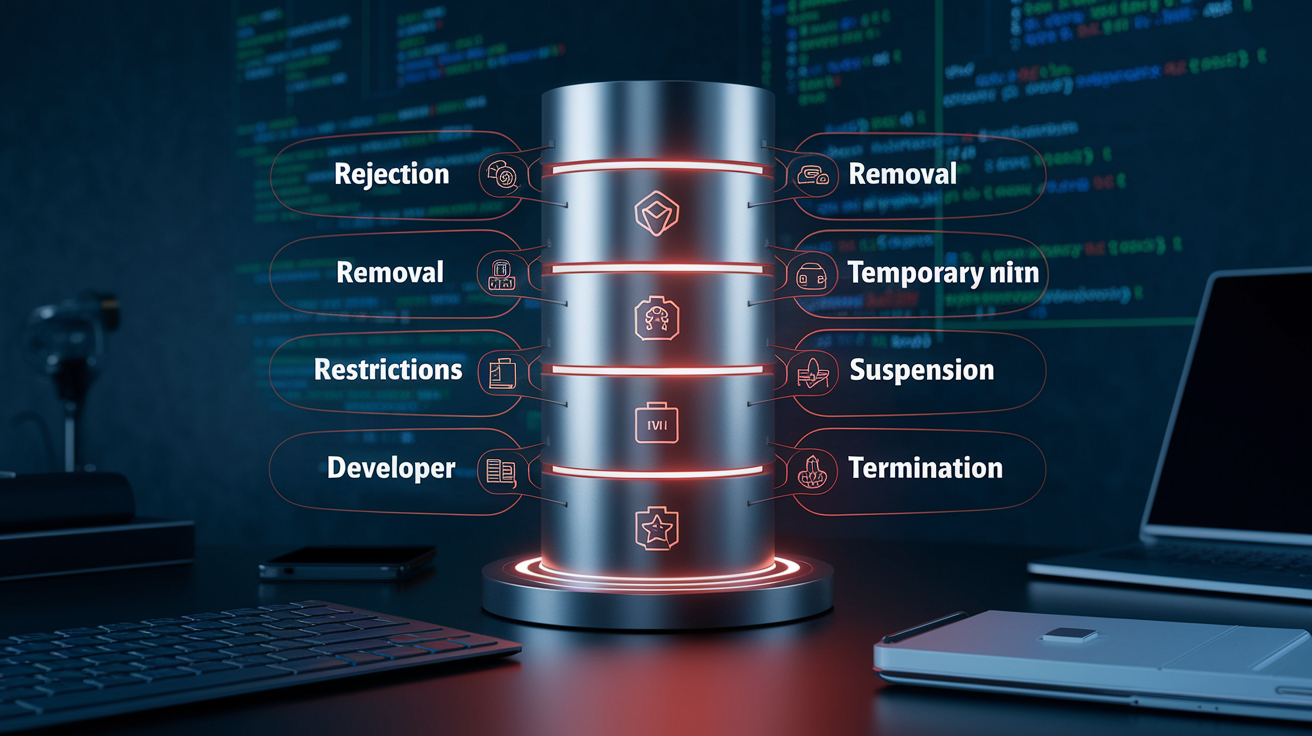
The escalation path begins with rejection or a compliance notice sent through App Store Connect. If an app update violates privacy rules, Apple blocks the update and provides a reason code referencing the specific guideline. Developers can resubmit once the issue is fixed. If the violation is discovered in a live app, Apple sends a notice giving the developer a short window (typically 14 days) to submit a corrective update. Failure to respond or submit a compliant fix results in app removal.
When violations are repeated, severe, or involve intentional deception, Apple skips intermediate steps and moves directly to account-level sanctions. Temporary suspensions freeze the developer’s ability to publish new apps or updates while Apple conducts a deeper audit of all apps under the account. If the audit uncovers systemic noncompliance (such as hidden tracking across multiple apps, refusal to honor deletion requests, or use of private APIs to evade privacy controls), Apple escalates to account termination. Terminated accounts lose all App Store distribution permanently, and developers are prohibited from creating new accounts.
Five common violation triggers that initiate escalation:
Hidden tracking or fingerprinting. Collecting device signals (IP address, screen resolution, installed app lists) to identify users without consent.
Misleading or incomplete privacy nutrition labels. Omitting data types actually collected or inaccurately describing data-sharing practices.
Refusal to implement ATT. Accessing IDFA or tracking users across apps without displaying the mandatory consent prompt.
Failure to honor user deletion requests. Ignoring or delaying data deletion after a user submits a request through the app.
Use of private or deprecated APIs. Calling undocumented system functions to bypass privacy restrictions or access data that public APIs protect.
Penalty Structures and Real-World Enforcement Examples Against Apple and Developers
Apple received four fines in 2025 totaling $851 million: two for abusing its dominant position under antitrust law and two for privacy-law violations. The largest single penalty was a €500 million fine imposed under the Digital Markets Act (DMA) in April 2025 for technical and commercial restrictions that prevented developers from steering users to alternatives outside the App Store. Despite the fine, reports indicated Apple continued noncompliant behavior, prompting the European Commission to open new preliminary findings in June 2025 over alternative app store barriers and the Core Technology Fee structure. Under DMA enforcement rules, periodic penalty payments can begin retroactively from the day the infringement was committed and can reach up to 5% of average daily worldwide turnover per day. Ultimate DMA fines can reach 10% of total worldwide turnover in the preceding financial year.
Regulatory fines for privacy breaches can reach 6% of total annual global revenue under EU privacy law. Comparative 2025 enforcement data shows Apple’s $851 million in fines was lower than Google’s $4.2 billion and Amazon’s $2.5 billion but significantly higher than Meta’s $228 million. When measured against free cash flow, Proton’s Tech Fines Tracker calculated that Apple could pay all four 2025 fines in 3 days, 3 hours, and 28 minutes. Big Tech’s combined 2025 fines of $7.8 billion would take 28 days and 48 minutes to pay from concurrent free cash flow, illustrating that statutory maximum penalties often function as a cost of doing business rather than a meaningful deterrent.
Developers face different penalty structures. App-level enforcement begins with warnings, proceeds to rejections or temporary feature restrictions, and escalates to app removal or developer account termination. Revenue loss from app removal can be immediate and total for developers dependent on App Store distribution. Developers who mislead users about data practices or refuse to fix privacy violations risk class action litigation in addition to Apple sanctions.
| Case | Violation | Penalty |
|---|---|---|
| Apple (April 2025, DMA) | App Store anti-steering; technical and commercial restrictions on alternative distribution | €500,000,000 fine + removal of restrictions ordered |
| Meta (April 2025, DMA) | Binary “consent or pay” model for Facebook and Instagram without equivalent less-personalized alternative | €200,000,000 fine + ongoing compliance assessment |
| Developer (generic example) | Hidden IDFA tracking, misleading privacy label, refusal to implement ATT | App removal + developer account termination |
For a detailed breakdown of how the DMA non-compliance decisions work and their broader enforcement context, see Understanding the Apple and Meta Non-Compliance Decisions Under the Digital Markets Act.
Apple Appeals, Investigations, and Remediation Expectations

Developers who receive a rejection or removal notice can submit an appeal through App Store Connect or request a phone call with Apple’s App Review Board. Appeals must include evidence that the app complies with the cited guideline: updated privacy policies, revised consent flows, removal of offending SDKs, or documentation showing the violation was a labeling error rather than a substantive data-handling failure. Apple typically responds to appeals within 24 to 72 hours for urgent issues and up to two weeks for complex cases requiring engineering review.
When Apple or a regulator opens a formal investigation, developers must provide comprehensive documentation: audit logs showing data collection events, consent records proving ATT prompts were displayed, copies of third-party SDK agreements, and evidence of data retention policies and deletion workflows. Developers who can’t produce these records face immediate adverse inferences during the investigation. Remediation timelines are short. Apple often requires a corrective update within 14 days of a violation notice. Developers who miss the deadline lose their apps from the App Store until compliance is restored.
Four types of evidence developers must submit during an investigation or appeal:
Consent records and ATT prompt screenshots. Timestamped logs showing when the ATT prompt was displayed, user response (allow or deny), and how the app handled each response.
Updated privacy nutrition labels and policy text. Revised disclosures that accurately reflect current data practices, submitted in parallel with the appeal.
Third-party SDK audit reports. Documentation from SDK vendors detailing what data the SDK collects, how it is transmitted, and whether the SDK respects ATT denial.
Data deletion logs and retention policies. Evidence that user deletion requests were honored within the promised timeframe and that data retention limits are enforced programmatically.
Technical Requirements to Avoid Apple Privacy Enforcement Actions

Apple evaluates encryption, access controls, and telemetry minimization during app review. Data transmitted to backend servers must use TLS 1.2 or higher. Apps that transmit user data over unencrypted HTTP connections are rejected. Data at rest must be protected using iOS-provided encryption mechanisms such as Data Protection APIs, and sensitive data (health records, financial information, authentication tokens) must be stored in the Keychain or encrypted containers. Developers who use private or undocumented APIs to access user data bypass Apple’s privacy controls and trigger automatic rejection. Excessive logging (such as recording device identifiers, location coordinates, or user behavior events that aren’t necessary for core app functionality) is flagged as high-risk.
Backend systems must enforce role-based access controls so that only authorized personnel can access user data. Apple expects developers to implement least-privilege principles: analytics teams shouldn’t have access to raw user identifiers, and customer support staff should access only the minimum data required to resolve a support ticket. Apps that collect telemetry for performance monitoring must anonymize or pseudonymize the data before transmission and must not correlate telemetry events with advertising identifiers or cross-app user profiles.
Five essential technical controls to avoid enforcement actions:
TLS 1.2 or higher for all network traffic. Unencrypted data transmission over HTTP is rejected during review.
iOS Data Protection APIs for sensitive data at rest. Health, financial, and authentication data must use file protection classes that require device unlock.
Keychain storage for credentials and tokens. Passwords, API keys, and session tokens must not be stored in UserDefaults or plain-text files.
Pseudonymization of telemetry and analytics. Replace user identifiers with one-way hashes or random session IDs before sending logs to backend servers.
Restrict use of device fingerprinting signals. Don’t collect or combine IP addresses, screen dimensions, installed app lists, or hardware identifiers to re-identify users who denied tracking consent.
Data Governance Obligations Under Apple Privacy Rules

Apple requires developers to define and enforce data retention limits. Privacy policies must specify how long each category of user data is retained and when it is deleted. Apps that promise “we delete your data after 30 days” must implement automated deletion processes that run on schedule and can be audited. Developers who retain data indefinitely or fail to honor stated retention periods face enforcement actions when users or regulators request proof of compliance.
Anonymization and pseudonymization are encouraged when data must be retained for analytics or business operations. Anonymization removes all identifiers permanently, making it impossible to link data back to an individual. Pseudonymization replaces direct identifiers with pseudonyms or hashes that can be reversed only with a key held separately. Apple expects developers to document which technique is used and to demonstrate that anonymization is irreversible or that pseudonymization keys are protected and not shared with third parties. Apps must also provide users with access and portability options: users can request a copy of their data in a machine-readable format, and developers must fulfill these requests within a reasonable timeframe. Data breach notification expectations are inherited from applicable privacy laws. Developers must notify users and regulators promptly when unauthorized access or data loss occurs.
Special Privacy Categories: Children, Health, Financial and Location Data

Apple enforces heightened privacy rules for apps in sensitive categories. Children’s apps must comply with the Children’s Online Privacy Protection Act (COPPA) in the United States and equivalent laws in other jurisdictions. These apps can’t collect personal data from children without verifiable parental consent, must implement parental gates (neutral-design prompts that prevent accidental purchases or data sharing), and can’t serve behavioral advertising to children. Apps that target children and include third-party analytics or advertising SDKs are rejected unless the developer proves the SDKs don’t track or profile child users.
Health and fitness apps that collect medical information, biometric data, or activity logs must use HealthKit or ResearchKit frameworks when applicable, restrict data sharing to only those parties explicitly disclosed in the privacy policy, and obtain affirmative consent before syncing health data to cloud servers. Financial apps that handle payment credentials, account numbers, or transaction histories must implement multi-factor authentication, tokenize sensitive data, and comply with PCI DSS or equivalent standards. Location data is considered high-risk: apps must request location permissions with clear justification, use the least-precise location mode necessary (coarse rather than precise when possible), and stop collecting location data when the feature requiring it isn’t actively in use.
Four high-risk data types requiring special handling:
Children’s personal information. Name, email, location, photos, or persistent identifiers collected from users under 13 (or under 16 in some jurisdictions) require verifiable parental consent.
Health and biometric data. Heart rate, step counts, medical diagnoses, facial scans, and fingerprints must use HealthKit or equivalent secure frameworks and can’t be sold or shared for advertising.
Financial account credentials. Credit card numbers, bank account details, and authentication tokens must be stored in the Keychain and transmitted only over encrypted channels.
Precise location data. GPS coordinates, Wi-Fi BSSID lists, and real-time movement tracking must be limited to features that require precise positioning (navigation, ride-sharing pickup) and must pause when those features are idle.
Preparing for Apple Privacy Audits and Continuous Monitoring

Apple and regulators trigger audits when apps exhibit red flags such as unexplained network traffic to third-party ad servers, mismatches between privacy labels and observed data flows, or user complaints alleging hidden tracking. Developers reduce enforcement risk by implementing continuous monitoring of SDK behavior, tracking consent prompt display rates, and logging data access events internally. Automated compliance tools can scan app binaries for private API usage, validate that ATT prompts appear before IDFA access, and flag discrepancies between declared data practices and actual network payloads.
Developer training on privacy rules is essential. Engineering, product, and legal teams should review Apple’s App Store Review Guidelines and privacy documentation quarterly, track updates to ATT requirements, and run internal audits before submitting updates. Risk scoring for app portfolios helps prioritize compliance efforts: apps with high download volumes, sensitive data handling, or complex SDK integrations receive more frequent manual review. Preparing evidence in advance (consent logs, retention policies, SDK vendor certifications) speeds up responses during audits and reduces the likelihood of prolonged investigations. Enforcement trends show that proactive monitoring is necessary: Apple was fined a total of $851M last year for privacy and antitrust violations, signaling that even large platform operators face significant penalties and motivating developers to adopt defensive compliance practices.
Five continuous monitoring strategies to reduce audit risk:
Automated binary scanning for private API calls. Use static analysis tools to detect use of undocumented or deprecated APIs before submission.
Real-time consent prompt tracking. Log every instance when the ATT prompt is displayed, the user’s response, and subsequent data flows to verify compliance.
Third-party SDK version audits. Maintain an inventory of all SDKs, track updates, and review SDK release notes for changes to data collection behavior.
Network traffic inspection. Capture and review outbound network requests during QA to confirm that no tracking data is sent when users deny consent.
Quarterly privacy policy and label reviews. Compare the privacy nutrition label, privacy policy text, and actual app code to identify and correct discrepancies before Apple detects them.
Final Words
You saw how Apple enforces privacy: app review, rejections, removals, fines, and account sanctions. The post also covered required privacy-policy elements, ATT consent rules, escalation steps, and the technical and governance controls developers should use.
There’s a clear path: spot risky practices, fix disclosures and SDKs, and prepare documentation for appeals and audits.
Keep these checks in place and you’ll cut the risk of apple privacy policy enforcement and penalties for noncompliance — and keep your app in front of users.
FAQ
Q: Which iPhones will no longer work in 2027?
A: iPhones that will no longer work in 2027 are those Apple or carriers stop supporting—usually models that can’t run the required iOS. Check Apple’s official compatibility page and your carrier’s notices for specifics.
Q: How to check if your iPhone is being monitored?
A: To check if your iPhone is being monitored, look for unusual battery drain, high data use, unknown apps or Configuration Profiles, unexpected pop-ups, changed privacy settings; run a security scan and remove suspicious profiles.
Q: How much do I get as part of Apple’s privacy settlement?
A: The amount you get as part of Apple’s privacy settlement depends on the specific settlement, your eligibility, and claim details; check the settlement notice or administrator website for per‑claim payment amounts and deadlines.
Q: What are the consequences of privacy non-compliance?
A: Consequences of privacy non-compliance include regulatory fines (sometimes a percentage of revenue), app rejection or removal, developer account suspension or termination, legal claims, lost revenue, and reputational damage.