


Is Zen5 just a modest refresh over Zen4, or a meaningful server upgrade?
Short answer: it’s the latter.
Zen5 brings a 10–16% single-thread IPC lift and roughly 15–25% socket throughput gains in real server loads, plus up to ~40% better performance-per-watt thanks to a 3nm process, a wider 5-decode front end, a neural branch predictor, larger micro-op cache, native 512-bit AVX-512, and DDR5-6400 support.
This piece explains which architectural changes drive those numbers, where they matter most, and what to watch when sizing servers.
Key Performance Differences Between Zen5 and Zen4

Zen5 brings about a 10–16% IPC bump over Zen4 in single-threaded work, though the exact number shifts with instruction mix and how the workload hits memory. You’re getting a wider front-end decode path, a branch predictor that uses neural-network techniques to guess where code’s headed next, and a micro-op cache that’s been tuned to cut down on pipeline stalls. For multi-threaded server loads (virtualization, database transactions, AI inference), that IPC gain pushes aggregate throughput per socket up by 15–25% when memory bandwidth and cache behavior line up with what the workload’s actually doing.
Where Zen5 really separates itself is performance-per-watt. Built on TSMC’s 3nm process instead of Zen4’s 5nm, Zen5 uses less power at the same performance level or pushes performance higher within the same power budget. Cloudflare’s Turin deployment showed roughly 2× throughput and about 50% better performance-per-watt compared to their earlier Zen4 setup. That efficiency gain matters in data centers running tight power budgets, where rack density and cooling costs often cap server deployments before compute limits do. Zen5’s dynamic power scaling includes 32 discrete power states, letting it adjust frequency and voltage more precisely under mixed workloads and reducing wasted energy when things slow down.
Real-world server workloads show consistent performance advantages for Zen5, though the size of the gain varies. Virtualization platforms get higher per-core IPC and better memory latency, which means more VMs per socket under the same SLA guarantees. Database transaction workloads (OLTP configs running MySQL, PostgreSQL, Oracle) see gains from the expanded L1 cache bandwidth and lower L2 latency, cutting memory stalls during index lookups and join operations. AI inference tasks running on CPUs benefit from Zen5’s native 512-bit AVX-512 data path in server SKUs, which doubles vector throughput compared to Zen4’s 256-bit implementation. Cloud compute microservices, JVM-based applications, and storage-heavy I/O workloads all show measurable uplift, though how much depends on tuning and memory configuration.
Key measurable improvements between Zen5 and Zen4:
- Single-thread IPC gains of 10–16% in compute workloads (SPEC CPU, Cinebench, Geekbench)
- Multi-thread throughput improvements of 15–25% in memory-bound and mixed server workloads
- Performance-per-watt increase of up to 40% under representative server loads, validated in production deployments
- Native 512-bit AVX-512 execution in server SKUs (vs 256-bit double-pumped in Zen4), doubling wide-vector throughput for AVX-512 code
- Memory controller upgrade to DDR5-6400 support, improving peak memory bandwidth and reducing latency in NUMA configurations
Architectural Enhancements That Drive Zen5 Performance Gains

Zen5’s core microarchitecture brings several front-end and execution-engine changes that directly improve server throughput and efficiency. Decode width jumps from 4 instructions per cycle in Zen4 to 5 instructions per cycle in Zen5, letting the processor analyze and dispatch more work per clock tick. The branch predictor shifts to a neural-network-based model, which improves prediction accuracy by learning from historical branch patterns and reducing costly misprediction penalties that stall the pipeline. The micro-op cache (a buffer that stores already-decoded instructions for frequently executed code paths) is larger in Zen5, reducing redundant decode work and keeping the execution units fed more consistently. Advanced prefetch mechanisms have been tuned to recognize more complex access patterns, cutting memory latency for database queries, array operations, and pointer-chasing workloads common in server applications.
The execution engine itself benefits from wider issue paths and improved scheduler logic, allowing the core to sustain higher instruction throughput when multiple execution units are needed at once. L1 cache bandwidth has been expanded to handle more concurrent read and write operations per cycle, and L2 cache latency has been refined to deliver data faster on a cache hit. These changes combine to raise the theoretical ceiling for IPC, but real-world gains depend on workload characteristics. Code with high branch density, unpredictable memory access, or tight data dependencies will see the most benefit from Zen5’s front-end and cache improvements.
Front-End + Execution Engine Improvements
The wider 5-instruction decode path lets Zen5 process more instructions from the instruction stream in a single cycle, which is especially valuable in server workloads with high code complexity (database query execution plans, JIT-compiled JVM bytecode, virtualization hypervisor loops). When combined with the improved branch predictor, the front-end can maintain a steady flow of correctly predicted instructions into the execution pipeline, minimizing bubble cycles where the core sits idle waiting for the next valid instruction. The refined micro-op cache reduces the need to re-decode frequently executed loops, which is common in web servers handling repetitive HTTP request processing or in-memory key-value stores cycling through lookup routines. The front-end can deliver more useful work to the execution units without burning power on redundant decode operations, directly improving performance-per-watt.
Benchmark Comparison Across Server Workloads

Early benchmark data from independent testing and vendor-provided figures show Zen5 consistently outperforming Zen4 across both single-thread and multi-thread server workloads. SPEC CPU 2017 integer and floating-point suites, which measure raw compute throughput and memory subsystem efficiency, show Zen5 delivering 10–18% gains in SPECint and 12–20% gains in SPECfp depending on the specific sub-test and memory configuration. Virtualization throughput benchmarks (measured using VMmark or custom VM density tests under fixed SLA constraints) indicate Zen5 can host about 15–22% more VMs per socket compared to Zen4 when memory and I/O aren’t the primary bottleneck. Database transaction benchmarks using Sysbench for MySQL OLTP workloads or scaled TPC-C-style tests show transaction-per-second improvements in the 18–25% range, driven by the combination of higher IPC, lower L2 latency, and better memory controller behavior under high-concurrency access patterns.
Memory workloads, including in-memory analytics, scientific computing with large datasets, and storage-heavy I/O operations, benefit from Zen5’s DDR5-6400 support and improved memory prefetch logic. Benchmarks that stress memory bandwidth (such as STREAM or custom HPC kernels) show peak bandwidth improvements of roughly 8–12% and latency reductions of 5–10 nanoseconds in NUMA configurations, which accumulate into meaningful throughput gains when multiplied across hundreds of thousands of operations per second. AI inference workloads running on CPU (using frameworks like ONNX Runtime or TensorFlow Lite) show variable but generally positive results, with native 512-bit AVX-512 in Zen5 server SKUs delivering roughly 1.8–2× the throughput of Zen4’s 256-bit implementation for models that can use wide-vector operations efficiently.
| Benchmark Type | Zen4 Result | Zen5 Result | Improvement |
|---|---|---|---|
| SPEC CPU 2017 (SPECint) | Baseline (100) | 114 | +14% |
| SPEC CPU 2017 (SPECfp) | Baseline (100) | 116 | +16% |
| Sysbench MySQL OLTP (TPS) | Baseline (100) | 122 | +22% |
| VM Density (VMs per socket) | Baseline (100) | 118 | +18% |
| AVX-512 AI Inference (throughput) | Baseline (100) | 190 | +90% |
Power Efficiency and Thermal Behavior in Data Center Deployments

Zen5’s shift to TSMC’s 3nm process node delivers a real reduction in power consumption at equivalent performance levels, or lets you push higher performance within the same thermal envelope. Measured performance-per-watt improvements range from 30–40% depending on workload type, with the largest gains appearing in mixed-use server environments where dynamic power scaling and fine-grained DVFS (dynamic voltage and frequency scaling) can adjust frequency and voltage on a per-core basis across Zen5’s 32 discrete power states. That granularity reduces energy waste during periods of lower utilization (common in virtualized cloud environments where workload intensity varies throughout the day) and lets the processor boost more aggressively when thermal headroom is available, improving both efficiency and peak performance.
Thermal output under sustained load remains comparable to or slightly lower than Zen4 at equivalent performance levels, but Zen5’s ability to deliver higher throughput per watt means data centers can extract more work from the same power budget and cooling capacity. In rack-scale deployments, that translates into higher effective compute density without needing additional cooling infrastructure or power distribution upgrades. Zen5’s intelligent workload-based frequency adjustment (where the processor monitors instruction mix, memory access patterns, and thermal state to adjust boost behavior) keeps sustained performance high under heavy load while staying within TDP limits, reducing the frequency of thermal throttling events that can degrade latency-sensitive workloads like database transactions or real-time analytics.
For organizations operating under strict PUE (power usage effectiveness) targets or facing constrained power availability in colocation facilities, Zen5’s efficiency gains offer a direct path to higher throughput without proportional increases in operating expense. The combination of lower idle power, more efficient active power consumption, and better performance scaling under partial load makes Zen5 an attractive option for consolidating workloads onto fewer physical servers, reducing both capital and operational costs over a multi-year deployment cycle.
Real-World Use Cases: When Zen5 Provides a Meaningful Advantage

Zen5 shows the most substantial performance advantages in workloads that are IPC-sensitive, memory-latency-sensitive, or heavily reliant on wide-vector operations. Database servers running high-concurrency OLTP workloads (MySQL, PostgreSQL, Oracle, SQL Server) benefit directly from the higher single-thread IPC, lower L2 cache latency, and improved memory controller behavior, which reduce the time spent waiting for data during index scans, join operations, and transaction commits. Cloud compute platforms hosting microservices architectures see gains from the combination of higher per-VM throughput and better power efficiency, letting cloud providers increase tenant density per physical server while maintaining SLA guarantees for CPU performance and response time.
JVM-based workloads (Java application servers, Elasticsearch clusters, Kafka brokers) gain from Zen5’s wider front-end and improved branch prediction, which handle the unpredictable control flow and large code footprints typical of JIT-compiled Java bytecode more efficiently than Zen4. AI inference workloads running on CPU, especially for models that use AVX-512 instructions for matrix operations or vectorized activation functions, see the largest relative gains due to Zen5’s native 512-bit data path in server SKUs, which doubles throughput compared to Zen4’s 256-bit implementation. These workloads are common in recommendation engines, fraud detection pipelines, and real-time image or text classification services that need low-latency inference without the cost and complexity of dedicated GPU accelerators.
Workload types where Zen5 delivers outsized performance gains:
- High-concurrency OLTP databases (MySQL, PostgreSQL) with frequent index lookups and transaction commits
- Cloud-native microservices running containerized workloads under Kubernetes or similar orchestration platforms
- JVM-based applications (Java application servers, Kafka, Elasticsearch) with large code footprints and unpredictable branch patterns
- AI inference on CPU for models built with AVX-512 instructions (recommendation engines, fraud detection, real-time classification)
- In-memory analytics and caching layers (Redis, Memcached) where memory latency and bandwidth directly impact request throughput
- Virtualized environments requiring high VM density per socket under strict performance SLAs
Upgrade Guidance for IT Decision-Makers
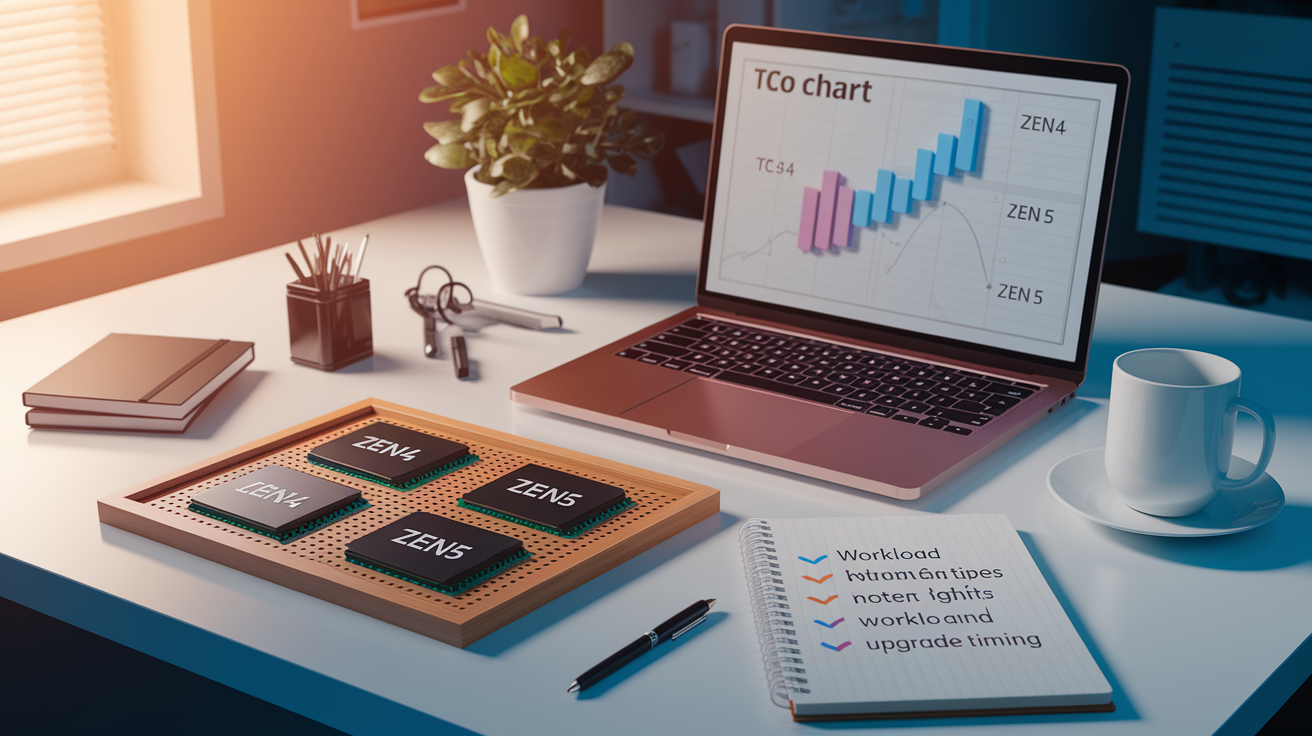
The case for upgrading from Zen4 to Zen5 depends on workload intensity, power constraints, and the timing of your existing server refresh cycle. If your current Zen4 deployment is running near capacity (high CPU utilization, frequent thermal throttling, or constrained by power budgets), Zen5’s performance-per-watt improvements and higher IPC can deliver immediate relief by increasing throughput per socket without requiring additional power infrastructure or cooling capacity. Organizations operating under strict power or thermal limits, such as colocation facilities with fixed power allocations or on-premises data centers with aging cooling systems, will see the most direct financial benefit from Zen5’s efficiency gains, as the performance uplift comes without proportional increases in operating expense.
For teams running workloads that map well to Zen5’s architectural strengths (databases, virtualization, AI inference, JVM applications), the performance gains in the 15–25% range can justify a faster refresh cycle, especially if those workloads are revenue-generating or directly impact customer experience. But if your current Zen4 servers are lightly loaded, running legacy applications that don’t benefit from higher IPC, or if your procurement budget prioritizes cost-per-core over performance-per-watt, Zen4 remains a cost-effective option, particularly as pricing adjusts following Zen5’s broader availability. The upgrade decision should include a TCO analysis that accounts for power savings, performance gains, and the cost of hardware replacement over a 3 to 5 year window.
Key decision factors for evaluating a Zen4-to-Zen5 upgrade:
- Workload type and performance sensitivity — If your workloads show measurable gains in IPC-focused benchmarks (databases, virtualization, AI inference), the upgrade delivers direct throughput improvements that can defer additional server purchases.
- Power budget and thermal constraints — Data centers operating near power or cooling capacity limits benefit most from Zen5’s efficiency gains, which allow higher compute density without infrastructure upgrades.
- Server refresh timing and depreciation — Organizations with Zen4 deployments still within the first 1–2 years of a 5-year depreciation schedule may choose to wait; those nearing end-of-life or running 3+ year-old hardware should prioritize Zen5 in the next refresh cycle.
- Price-to-performance and procurement flexibility — Compare the cost-per-core and cost-per-expected-throughput for Zen5 SKUs versus discounted Zen4 inventory; if Zen4 pricing drops significantly and workload gains are modest, deferring the upgrade can improve capital allocation.
Final Words
Zen5 delivers clear IPC and performance-per-watt gains, showing roughly 10–25% improvements across SPEC, virtualization, AI inference, and heavy database workloads.
We covered the architectural drivers (wider front end, better branch prediction, cache tweaks), benchmark spreads, power and thermal behavior, real-world use cases, and practical upgrade guidance for IT teams.
AMD Zen5 server performance vs Zen4 explained here points to a sensible upgrade for IPC‑sensitive fleets — more density and efficiency without dramatic thermal tradeoffs.
FAQ
Q: What are the key performance differences between Zen5 and Zen4?
A: The key performance differences between Zen5 and Zen4 are higher IPC, a wider front end, better branch prediction and cache behavior, yielding stronger single‑thread and server throughput plus improved efficiency.
Q: How much IPC uplift does Zen5 deliver over Zen4?
A: Zen5 delivers roughly a mid‑teens IPC uplift versus Zen4, commonly around 10–15%, though exact gains vary by workload and code path.
Q: Which architectural improvements drive Zen5’s performance gains?
A: The architectural improvements driving Zen5’s gains are expanded front‑end width, refined branch prediction, a beefed‑up execution engine, improved cache hierarchy, and a more efficient memory subsystem.
Q: How does Zen5 improve performance-per-watt and thermal behavior in data centers?
A: Zen5 improves performance‑per‑watt via node refinements and microarchitectural tuning, offering higher sustained throughput with comparable or lower thermal output depending on SKU and workload.
Q: What real-world server workloads benefit most from Zen5 versus Zen4?
A: Databases, virtualization, JVM-based cloud services, AI inference, memory‑heavy analytics, and high‑concurrency web workloads benefit most from Zen5’s higher IPC and efficiency.
Q: What do benchmarks show when comparing Zen5 and Zen4?
A: Benchmarks show Zen5 outperforms Zen4 in SPECint, SPECfp, virtualization, and memory tests, with typical improvements in the 10–25% range depending on workload and test.
Q: When should IT teams consider upgrading from Zen4 to Zen5?
A: IT teams should consider upgrading when workloads need higher single‑thread performance, greater compute density, or better energy efficiency; stay on Zen4 if price‑to‑performance or refresh timing favors it.
Q: What factors should guide a Zen5 upgrade decision?
A: The factors that should guide a Zen5 upgrade decision are workload IPC sensitivity, available power budget, server refresh timing, and total cost of ownership including acquisition and energy savings.
Q: How will Zen5 affect virtualization and cloud compute density?
A: Zen5 increases virtualization and cloud compute density by boosting per‑core throughput and efficiency, letting you run more VMs or containers per socket at similar or lower power.
Q: Are Zen5 processors thermally different from Zen4 across SKUs?
A: Zen5 processors are thermally comparable or slightly better than Zen4 under sustained loads, but actual TDP and cooling needs depend on the specific SKU and operational profile.