


Is Apple acting like Europe’s on-device privacy enforcer?
Apple has reshaped its privacy policy and controls to align with GDPR: App Store “privacy labels,” App Tracking Transparency, and Privacy Manifests give clearer notices and let iOS enforce consent at the OS level.
That moves some enforcement from regulators into the platform and makes data flows visible, but developers still must handle formal GDPR duties—access, portability, erasure—so Apple’s tools raise the compliance floor without removing legal obligations.
Key Changes in Apple’s Privacy Policy Under GDPR Requirements

GDPR went live in May 2018, and it forced platforms to get real about how they handle personal data. Apps had to establish a lawful basis for processing, tell users about breaches within 72 hours, respect access and deletion rights, and bake privacy into their design from the start. For Apple, that meant rethinking how the entire iOS ecosystem collects, shares, and controls user data.
Apple didn’t flip a switch overnight. They rolled out platform-level privacy tools in stages, each one mapping to GDPR principles but enforced directly by the operating system.
First came Privacy Nutrition Labels in December 2020. You’d see a summary of what data each app collects, whether it’s linked to you, and whether it’s used for tracking. Then in April 2021, App Tracking Transparency (ATT) launched. Apps now had to ask explicit permission before accessing your Identifier for Advertisers (IDFA) or tracking you across apps and websites. Apple’s definition of “tracking” is pretty specific: linking your data from one app with third-party data for ads, measurement, or selling to data brokers.
At WWDC 2023, Apple introduced Privacy Manifests. These are structured files that apps and third-party SDKs have to submit, listing collected data types, tracking domains, and any API usage that needs a reason. Starting May 1, 2024, App Store Connect began rejecting apps that don’t properly document their API usage.
These changes line up with GDPR user rights pretty directly. Transparency labels and manifests help you understand what data exists and where it goes, which makes it easier to exercise your access, portability, and deletion rights. ATT implements opt-in consent the way GDPR requires for targeted advertising. When you decline ATT, iOS blocks network traffic to all the domains the app listed as tracking domains. Consent gets enforced at the OS level. Developers still have to handle individual GDPR requests, but Apple’s tools make it much harder to hide noncompliance.
How Apple’s Transparency Tools Reflect GDPR Requirements
Privacy Nutrition Labels work like a GDPR-style privacy notice built into the App Store. Each app has to disclose what personal data it collects (Contact Information, Health and Fitness, Financial Information, Location, Search History, User Content, Purchases) and say whether that data is linked to your identity or used for tracking. You see the labels before you download, which mirrors GDPR’s requirement to be transparent at the point of collection.
When Privacy Manifests arrived in 2023, Apple closed the gap between what apps say in the App Store and what they actually do at runtime. Manifests are machine-readable files that declare the same data categories as Nutrition Labels, but they also specify tracking domains, required-reason API usage, and whether the app or its SDKs perform tracking. The two systems are supposed to align. A developer’s manifest feeds into their Nutrition Label, and Apple can cross-check both against the app’s actual network requests and API calls. This supports GDPR’s accountability principle: you don’t just disclose what you do, you prove it.
Post-GDPR transparency improvements in Apple’s ecosystem include:
- Pre-download privacy summaries that map data types to GDPR categories (special-category data like health, location as personal data).
- Tracking flags that clarify whether data is shared with third parties for advertising or measurement.
- Required-reason API declarations that prevent silent fingerprinting and signal when an app accesses device identifiers.
- Xcode Privacy Reports that aggregate manifest data from the app and all bundled SDKs into a single PDF, acting as a living privacy audit.
- Signed manifests from third-party SDKs, ensuring that privacy declarations are tamper-evident and can be verified across the supply chain.
Consent Mechanisms: Apple’s ATT vs GDPR Requirements
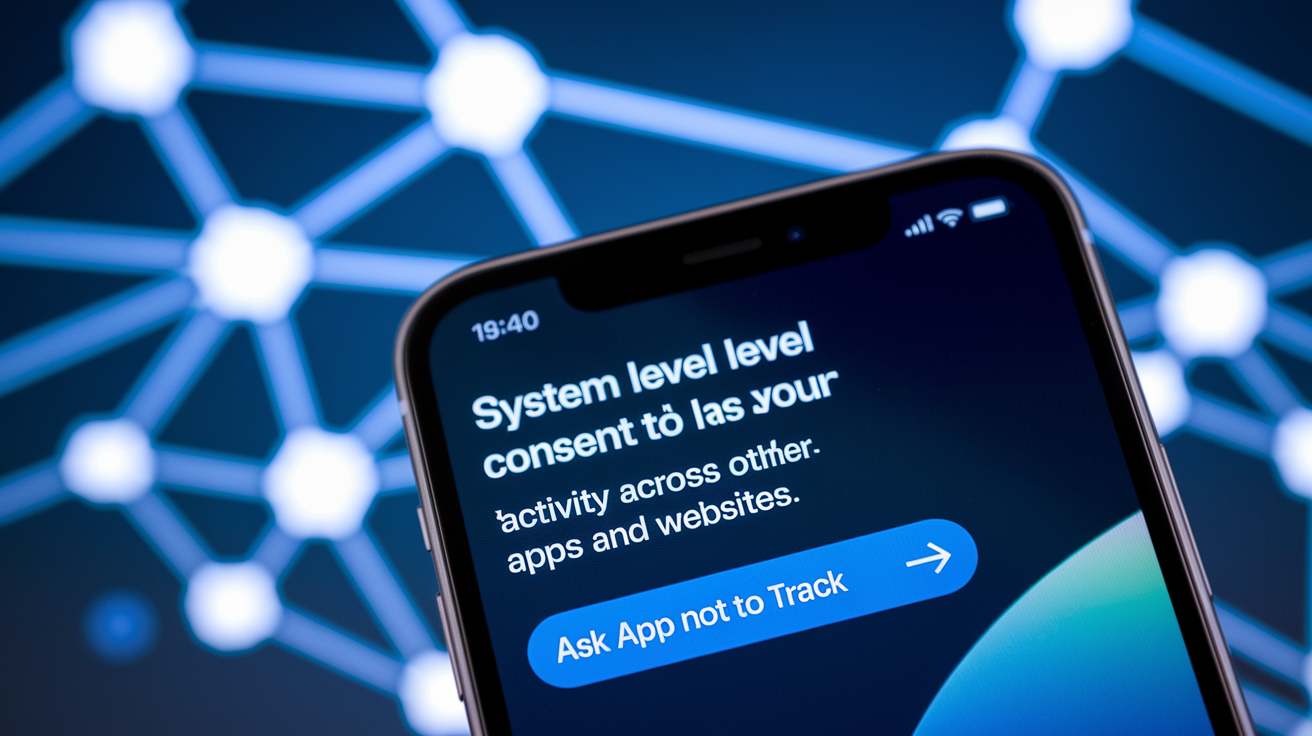
App Tracking Transparency and GDPR consent obligations overlap, but they’re not the same thing. Knowing where ATT stops and a Consent Management Platform (CMP) starts is critical.
ATT Consent Flow
App Tracking Transparency rolled out in April 2021 and displays a system-level pop-up: “Allow [App Name] to track your activity across other companies’ apps and websites?” If you select “Ask App Not to Track,” the app loses access to the IDFA and can’t track you via any other identifier (email addresses, device fingerprints). Before ATT, roughly 70% of iOS users shared their IDFA with apps. After ATT, opt-in rates dropped to around 10–15%.
When you decline ATT, iOS blocks all outgoing network requests to domains the app listed in its NSPrivacyTrackingDomains manifest entry. This happens at the OS level. Tracking endpoints simply receive no traffic, and SDKs relying on those domains partly or completely stop working.
GDPR Consent Requirements
GDPR requires affirmative, informed, specific, and freely given consent for each processing purpose. A CMP collects and records consent for things like personalized advertising, analytics, partner data sharing, and cookie placement. It has to let you grant or deny consent granularly (purpose by purpose, vendor by vendor), document the lawful basis for each type of processing, and support withdrawal at any time. CMPs also manage legal obligations outside ATT’s scope: recording consent timestamps, integrating with the IAB Transparency and Consent Framework (TCF), and handling data subject requests for access, rectification, and deletion.
Here’s how ATT and GDPR responsibilities compare:
- Scope: ATT covers cross-app/web tracking and IDFA access. GDPR covers all personal data processing purposes.
- Enforcement: ATT is enforced by iOS through OS-level blocking and App Store rejection. GDPR is enforced by Data Protection Authorities through audits, fines, and legal orders.
- Granularity: ATT is binary (track or don’t track). GDPR consent is purpose-specific and vendor-specific.
- Documentation: ATT records your choice in system settings. GDPR requires controllers to log consent signals, timestamps, and the exact information shown to you.
Developers need to implement both ATT and a CMP. The recommended flow is either (1) request ATT permission first, then collect GDPR consents if granted, or (2) collect GDPR consents via CMP first, then request ATT. Both create a two-step consent UX. It’s more friction, but it’s legally defensible in the EU.
Data Rights Enhancements and How Apple Supports GDPR User Controls

GDPR gives you enforceable rights: access to your personal data, data portability (receiving data in a structured, machine-readable format), erasure (“right to be forgotten”), and the right to object to processing. Apple’s transparency tools support these rights indirectly by making data flows visible, but formal GDPR request handling is still the developer’s and data controller’s job.
Privacy Nutrition Labels and manifests give you the information you need to understand what data an app holds about you. When you want to exercise your right of access or portability, knowing which data categories are collected (location history, purchase records, health metrics) and where they’re sent (tracking domains, analytics partners) helps you submit targeted requests to the right controllers and processors. Apple’s own services (Apple ID, iCloud, App Store purchase history) offer self-service data export and account deletion through privacy.apple.com, modeling GDPR-aligned account management.
ATT’s domain-blocking mechanism works as an indirect deletion and objection tool. If you deny tracking, data that would have been sent to tracking endpoints is never transmitted in the first place. This “data minimization by blocking” reduces the volume of personal data in circulation and limits the need for后续 deletion requests. But it doesn’t replace formal erasure obligations. If data was already collected before you withdrew consent, the controller still has to delete it when you ask.
Practical Impact for EU Users
For users in the EU, Apple’s changes translate to stronger day-to-day controls. Transparency labels surface what would otherwise be hidden in privacy policies, helping you decide whether to download an app or request access to your data. ATT provides an on-device opt-out that triggers immediate, OS-enforced blocking. No need to contact the developer or file a complaint with a Data Protection Authority.
Privacy manifests and Xcode reports give you (and regulators) a technical audit trail that can be checked against GDPR records of processing activities. It’s harder for apps to quietly expand data collection without updating disclosures. These tools don’t fulfill every GDPR obligation, but they raise the baseline and shift enforcement from purely legal processes to technical and platform-level checks.
Privacy Manifests: Apple’s 2023–2024 Updates and Their GDPR Alignment

Privacy manifests were announced at WWDC 2023 and enforcement started May 1, 2024. They’re structured files that every new or updated app and every third-party SDK must include when submitted to the App Store. They formalize what was previously declared only in the App Store Connect interface and add technical details that Apple can verify at build time and runtime.
What Developers Must Declare
Each privacy manifest must contain four pieces of information:
- Type of data collected: the same categories used in Nutrition Labels (Contact Information, Health and Fitness, Financial Information, Location, Sensitive Info, User Content, Browsing History, Search History, Identifiers, Purchases, Usage Data, Diagnostics, Other Data Types).
- How the data will be used: declared purposes such as App Functionality, Analytics, Product Personalization, Developer Advertising, Third-Party Advertising, or Other Purposes.
- Whether the data are linked to the user: a boolean flag indicating if the data can be tied to your identity.
- Whether the data are used for tracking: the NSPrivacyTracking flag and a list of NSPrivacyTrackingDomains (specific hostnames that receive tracking data).
Developers also have to declare every use of a “required reason API,” which are system calls that could be misused for fingerprinting (querying filesystem timestamps, reading UserDefaults keys, accessing system boot time). Each API usage must be justified with one of Apple’s approved reasons. If an API is called but no reason is declared, App Store Connect will reject the submission after May 1, 2024.
Enforcement and OS Behavior
Apple enforces manifests in two ways. First, at submission: App Store Connect scans the app binary and bundled SDKs for required-reason API calls and checks whether the manifest documents them. Missing or incorrect declarations result in rejection.
Second, at runtime: when you deny ATT permission, iOS reads the app’s NSPrivacyTrackingDomains list and blocks all HTTP/HTTPS requests to those hostnames. The blocking is automatic and silent. Tracking endpoints see no traffic, and the app can’t bypass it. This OS-level enforcement is stricter than GDPR’s consent model, which relies on controllers honoring user choices. Apple removes the opportunity for noncompliance by cutting the network path.
| Manifest Requirement | GDPR Equivalent | Developer Obligation |
|---|---|---|
| Data types and purposes | Article 13/14 information (categories, purposes, legitimate interests) | Audit app and SDKs; declare all collected types and map to processing purposes |
| Tracking flag and domains (NSPrivacyTracking, NSPrivacyTrackingDomains) | Consent for tracking/profiling (Article 6(1)(a), Recital 47) | List all tracking endpoints; test runtime blocking when ATT is denied; ensure CMP covers non-tracking purposes |
| Required-reason API declarations | Data minimization (Article 5(1)(c)), prohibition of covert processing | Review Xcode privacy report; document legitimate use case for each API; remove unnecessary calls |
Third‑Party SDKs, Fingerprinting Limits, and Supply‑Chain Transparency

GDPR assigns responsibility to data controllers, but real apps bundle dozens of third-party SDKs (analytics, advertising, crash reporting, A/B testing), each acting as a data processor or joint controller. Apple’s manifest and signature requirements extend privacy obligations down the supply chain, forcing SDK vendors to declare their data practices in a machine-readable, verifiable format.
When you integrate an SDK, you inherit its data collection and tracking behavior. Under GDPR, the app publisher remains the controller (or joint controller) and has to ensure that every processor has a data processing agreement and complies with user rights. Apple’s approach makes this auditable. Each SDK must ship a signed privacy manifest listing the data it collects, the APIs it calls, and the tracking domains it contacts. Developers can generate an Xcode Privacy Report that aggregates their app’s manifest with all bundled SDK manifests, producing a single PDF that shows the full data footprint. This supports GDPR’s accountability principle: controllers can prove what data is processed and by whom.
Real examples show how SDKs adapted. Braze’s Swift SDK published a privacy manifest in version 7.5.0 declaring default data types and no tracking. In version 7.6.0, Braze added methods for brands to mark specific user attributes as “tracking” data and route them to a dedicated tracking URL, which is blocked by iOS if you decline ATT. AppsFlyer’s SDK version 6.14.0 includes a manifest listing data types (NSPrivacyCollectedDataTypePurposeThirdPartyAdvertising) and required-reason APIs (File Timestamp APIs, User Defaults APIs). AppsFlyer’s documentation recommends that developers list any DNS CNAME aliases used for data collection as tracking domains, because iOS blocks requests by resolved hostname.
Apple prohibits using required-reason APIs or device signals to fingerprint users, even if ATT consent is granted. Fingerprinting (deriving a persistent identifier from the combination of device properties like screen resolution, installed fonts, timezone, battery level, and free disk space) is banned outright. This aligns with GDPR’s data minimization and purpose limitation principles: even with consent for tracking, controllers can’t create hidden identifiers that circumvent user choices.
Practical steps for developers managing third-party SDKs:
- Request manifests from every SDK vendor and verify that each manifest is signed by Apple (signature ensures it hasn’t been tampered with after publication).
- Validate tracking domains in each SDK’s manifest and confirm they match actual network behavior using network debugging tools.
- Review required-reason API usage in the Xcode Privacy Report and confirm that each API call is justified and documented.
- Test ATT opt-out scenarios by denying tracking permission and confirming that tracking endpoints are blocked, analytics continue to function (if not using tracking domains), and no crashes occur.
Comparing Apple’s GDPR-Influenced Privacy Strategy with Competitors
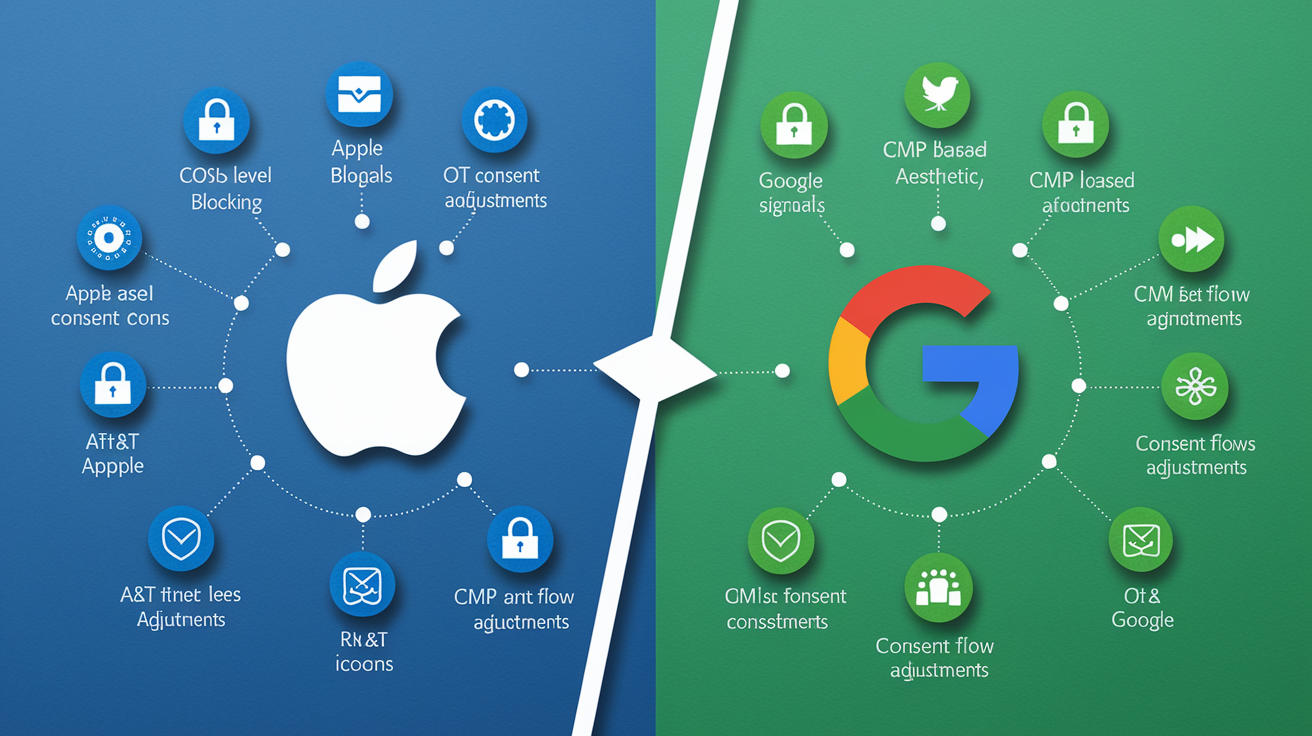
Apple’s approach to GDPR compliance is prescriptive and platform-enforced. Google and the Play Store rely more on developer declarations and tag-based consent signaling. Both strategies respond to GDPR, but they differ in enforcement mechanism, consent granularity, and technical architecture.
Apple enforces privacy rules at the OS and App Store level. ATT is a system dialog. Denial triggers automatic blocking of tracking domains by iOS networking APIs. Privacy manifests are validated at app submission and linked to runtime behavior. Apple can detect when an app calls a required-reason API without declaring it, or when network traffic is sent to an undeclared tracking domain. Developers who don’t comply face App Store rejection and, if they’re circumventing ATT, account termination. The technical enforcement is strict and automatic.
Google introduced Play Store “Data safety” labels in 2022 (similar to Apple’s Nutrition Labels) and launched Consent Mode v2 in late 2023, with enforcement in the European Economic Area starting March 2024. Consent Mode v2 adds two parameters (aduserdata for personalized advertising, adpersonalization for remarketing) on top of the original adstorage and analytics_storage flags. These are consent signals sent to Google’s advertising and analytics services. They don’t block network requests. Instead, Google’s tags read the signals and adjust behavior: in Basic mode, tags don’t load until consent is granted; in Advanced mode, tags load immediately but send only a cookieless ping until consent is obtained. The enforcement depends on publishers implementing Consent Mode correctly and on Google respecting the signals. There’s no OS-level blocking.
| Aspect | Apple (ATT + Manifests) | Google (Consent Mode v2 + Data Safety) |
|---|---|---|
| Enforcement Method | OS-level network blocking; App Store submission validation; automatic rejection for missing manifest entries | Publisher-implemented consent signals; Google tag behavior changes based on signals; Play Store listing review |
| Consent Control | System dialog (ATT) for tracking; binary (allow/deny); blocks all traffic to declared tracking domains when denied | CMP integration; granular per-purpose/per-vendor consents (TCF); Basic mode prevents tag load, Advanced mode sends cookieless ping |
| Technical Impact | IDFA access restricted; tracking SDKs can fail entirely; required-reason APIs must be justified; supply-chain manifests required | Google tags adapt based on consent parameters; no OS-level blocking; relies on advertiser/publisher honoring CMP signals and Google respecting mode settings |
The practical difference: Apple’s model enforces privacy technically and preemptively. Tracking can’t happen if you say no, because the OS blocks it. Google’s model enforces privacy contractually and procedurally. Tracking shouldn’t happen if you say no, because the publisher’s CMP and Google’s tags are configured to respect your choice. Both respond to GDPR’s consent requirements, but Apple removes discretion from the equation.
Global Impact Beyond the EU: GDPR Influence on Apple’s Worldwide Privacy Model

GDPR is an EU regulation, but Apple applied ATT, Privacy Nutrition Labels, and Privacy Manifests globally. Every iOS user worldwide sees the ATT dialog. Every app submitted to the App Store, regardless of target market, must include a privacy manifest. This universal rollout reflects a strategic choice: rather than fragment the platform by region, Apple built one privacy model that meets the strictest regulatory standard and deployed it everywhere.
The decision was driven partly by consumer expectations. Roughly 80% of consumers say transparency about data use is important for trusting a company, and more than one-third are willing to pay more for stronger privacy protections. GDPR set a regulatory floor, but user demand for privacy spans borders. By adopting GDPR-aligned controls globally, Apple differentiated its brand and avoided the complexity of region-specific codebases, consent flows, and App Store review processes.
IDFA restrictions affect global advertising markets. Before ATT, advertisers could retarget iOS users across apps and measure campaign performance with persistent identifiers. Post-ATT opt-in rates of 10–15% mean that 85–90% of iOS users are effectively anonymous to third-party advertisers, reducing targetable audience sizes and conversion attribution worldwide (not just in Europe). Android announced a comparable control (Apps Advertising ID opt-out, expanded under Privacy Sandbox), signaling that opt-in tracking is becoming the cross-platform norm.
Cross-regional implications of Apple’s GDPR-influenced model:
- Unified consent UX: developers build one ATT flow and one CMP flow, reducing engineering overhead and improving user consistency across markets.
- Regulatory arbitrage reduced: countries outside the EU (Brazil’s LGPD, California’s CCPA/CPRA, Canada’s PIPEDA) benefit from Apple’s global privacy baseline without needing to negotiate platform-specific changes.
- Supply-chain transparency everywhere: signed SDK manifests and required-reason API declarations create a global audit trail, helping developers comply with multiple frameworks (GDPR, CCPA, SOC 2, ISO 27001) using a single technical artifact.
Final Words
Apple has pushed a steady set of changes that put GDPR-style rules into the operating system: privacy labels, App Tracking Transparency, and required privacy manifests now shape what apps and SDKs can do.
That matters for users who get clearer control over access, portability, and deletion, and for developers who must declare data use, sign manifests, and test ATT behavior. The result: more technical enforcement and fewer surprises.
Bottom line: Apple privacy policy and GDPR: what’s changed shows a practical path toward stronger transparency and easier user control—good news for privacy and for teams planning ahead.
FAQ
Q: What are the key changes in Apple’s privacy policy due to GDPR?
A: The key changes in Apple’s privacy policy due to GDPR are Privacy Nutrition Labels (Dec 2020), App Tracking Transparency (Apr 2021) and mandatory Privacy Manifests (WWDC 2023, enforced May 1, 2024).
Q: How do Apple’s Privacy Nutrition Labels reflect GDPR transparency requirements?
A: Apple’s Privacy Nutrition Labels reflect GDPR transparency by listing categories like health, financial, location, user content and purchases, and they must align with developers’ privacy manifests for accurate disclosure.
Q: How does Apple’s App Tracking Transparency (ATT) work and enforce tracking limits?
A: Apple’s ATT works by showing an OS-level opt-in prompt for IDFA access; if denied, iOS blocks tracking domains and limits fingerprinting, enforcing consent and technical blocking at the system level.
Q: Does ATT satisfy GDPR consent obligations for apps in the EU?
A: ATT does not satisfy GDPR consent obligations; developers still must use a consent management platform, record lawful bases, capture multipurpose consent and keep audit trails for EU users.
Q: How does Apple support GDPR data subject rights like access, portability and deletion?
A: Apple supports GDPR rights with account dashboards, iCloud data visibility and clearer disclosures, but developers remain responsible for handling formal access, portability and deletion requests.
Q: What must developers declare in Apple’s Privacy Manifests?
A: Developers must declare four manifest items: data types collected, processing purposes, whether data is linked to an identifiable user, and any tracking or third‑party sharing uses.
Q: How are Privacy Manifests enforced and what happens if they’re incorrect?
A: Privacy Manifests are enforced by the App Store and OS: apps risk rejection for inaccurate manifests, and the system can block listed tracking domains using required-reason APIs and OS checks.
Q: How do Apple’s changes affect third‑party SDKs and fingerprinting practices?
A: Apple’s changes force SDKs to list tracking domains, prohibit fingerprinting, require signed manifests, and push developers to audit supply chains and validate third‑party tracking behavior.
Q: How does Apple’s privacy approach compare to Google’s Consent Mode v2?
A: Apple enforces privacy at the OS level with ATT and manifests, offering blocking and app-level enforcement; Google uses Consent Mode v2 signals and server-side controls for personalization and measurement.
Q: Will Apple’s GDPR-driven changes affect users and markets outside the EU?
A: Apple’s GDPR-driven changes affect users globally: ATT, nutrition labels and manifests apply worldwide, shifting ad markets, raising transparency expectations and influencing cross‑border data practices.