


What if your next phone could download a 4K movie in seconds and still last the day on one charge?
Snapdragon X Gen modems make that more than a sales pitch.
They combine wide carrier aggregation (10× mmWave, 5× sub‑6), an on‑modem tensor AI engine for smarter beam and handover decisions, and a new power-saving RF design.
The result is higher real-world throughput, lower latency for gaming and calls, stronger indoor and crowded-venue signals, and measurable battery gains.
Thesis: Snapdragon X Gen modem advantages deliver the superior 5G speed and efficiency you actually notice.
Key Real-World Advantages of Snapdragon X Gen Modems

Snapdragon X Gen modems boost download speeds through advanced carrier aggregation. We’re talking 10-carrier mmWave and 5× sub-6 GHz aggregation, which lets your device pull from multiple frequency channels at once. In a city with solid mmWave infrastructure, you’ll hit multi-gigabit peaks that turn a 4K movie download from minutes into seconds. Sub-6 aggregation pushes throughput higher in everyday coverage areas, making app loads, file syncs, and cloud backups noticeably faster even when mmWave isn’t around.
Latency drops for anything interactive. The X75’s dedicated hardware tensor accelerator cranks AI performance 2.5× higher than before, which means smarter beam management and quicker handover decisions. Cloud gaming sessions stay smooth when the network shifts, video calls drop fewer frames as you move between cells, and AR apps respond faster to what’s happening around you. AI-driven connection management keeps adjusting antenna tuning and RF parameters based on signal conditions, device orientation, and network congestion. Fewer retransmissions, more stable links indoors, at cell edges, and when you’re moving fast.
Indoor coverage gets better because AI models running on the modem itself predict signal drops and switch bands or beams before your connection weakens. You’ll see fewer dead zones in office buildings, parking garages, shopping centers. In crowded stadiums or transit hubs, ML-based interference mitigation keeps your connection steady when hundreds of devices are fighting for spectrum.
Six things you’ll actually notice:
- Faster downloads in mmWave hotspots and regular sub-6 zones thanks to multi-carrier aggregation
- More stable connectivity when you’re moving—car rides, train commutes, walking between buildings—because of predictive handover logic
- Improved indoor coverage with fewer signal drops in elevators, basements, and other RF-challenged spots
- Reduced lag for cloud gaming, video conferencing, and real-time collaboration tools
- Smoother streaming with less buffering and faster adaptive bitrate switches for 4K and 8K content
- Consistent performance in crowded places where AI-based resource management cuts down on contention and packet loss
Technical Performance Metrics and Benchmarks of Snapdragon X Gen Modems

Qualcomm puts X65 and X70 devices at up to 10 Gbps peak theoretical downlink, a ceiling set by maximum carrier aggregation and modulation schemes under perfect lab conditions. Real-world throughput depends heavily on carrier infrastructure, spectrum availability, and RF environment. The X75 increases practical sustained speeds through improved spectral efficiency. Better channel estimation, faster link adaptation, and reduced retransmission overhead rather than a higher theoretical peak. Users in well-provisioned networks with 5G Advanced features see higher average download rates and more consistent upload performance, especially when FDD uplink MIMO kicks in to boost upload capacity on sub-6 bands.
Latency expectations vary by network mode and provisioning. In 5G standalone deployments with low-latency slicing and good backhaul, X75 devices can hit over-the-air latencies in the low double-digit millisecond range, occasionally dipping below 10 ms in optimal conditions. Non-standalone networks typically add a few milliseconds due to LTE anchor overhead. The jump from X70 to X75 narrows latency variance under load. Fewer spikes during congestion or handovers, thanks to on-modem AI that predicts congestion and adjusts transmission timing proactively.
| Metric | X65 | X70 | X75 |
|---|---|---|---|
| Peak Theoretical Downlink | Up to ~10 Gbps | Up to ~10 Gbps | Higher real-world throughput via improved spectral efficiency |
| Latency (ideal SA network) | Low double-digit ms | Low double-digit to sub-10 ms | Sub-10 ms with reduced variance under congestion |
| Carrier Aggregation | Multi-carrier mmWave + sub-6 | Enhanced aggregation + AI signal processing | 10× mmWave, 5× sub-6, FDD uplink MIMO |
5G Band and Connectivity Support in Snapdragon X Gen Modems

Snapdragon X Gen modems support both mmWave (FR2) and sub-6 GHz (FR1) frequency ranges, which means global device compatibility across North America, Europe, Asia, and emerging markets. The X75 handles 10-carrier mmWave aggregation—critical in dense urban deployments where operators allocate multiple mmWave channels to boost capacity—and 5× sub-6 aggregation for broader geographic coverage. This dual-mode setup lets a single device roam seamlessly between high-speed mmWave hotspots and wide-area sub-6 networks without dropping connections or needing separate hardware modules.
FDD uplink MIMO on sub-6 bands improves upload reliability and throughput, addressing a common pain point in video calls and cloud uploads. The modem operates in standalone, non-standalone, and Dynamic Spectrum Sharing modes, which means compatibility with carriers at different stages of 5G rollout. SA mode offers lower latency and more efficient signaling. NSA anchors to existing LTE infrastructure for faster initial deployment. DSS allows operators to share spectrum dynamically between 4G and 5G, smoothing the transition for users and networks.
Broad international band coverage means travelers face fewer connectivity gaps. Snapdragon X modems support the major global 5G bands deployed across carriers, reducing the need for region-specific device variants and simplifying OEM product lines. You get consistent roaming performance whether you’re in New York, London, Seoul, or Mumbai.
Five real-world impacts of multi-band support:
- Seamless handoffs between mmWave and sub-6 preserve download sessions and video streams when moving between coverage zones
- Higher aggregate capacity in cities where operators deploy both mmWave small cells and macro sub-6 layers
- Better indoor penetration on sub-6 bands combined with mmWave speed boosts near windows and outdoor areas
- Simplified global device models that work across carriers and continents without hardware changes
- Faster network rollout support for carriers using DSS to transition spectrum from LTE to 5G incrementally
AI and Machine Learning Advantages in Snapdragon X Gen Modems

The X75’s hardware tensor accelerator—Qualcomm’s first dedicated on-modem AI engine—delivers 2.5× AI performance compared with the previous generation’s software-only approach. This accelerator runs machine-learning models directly on the modem silicon, which means real-time optimization of radio parameters without waiting for cloud inference or CPU intervention. The result? Faster, more accurate channel estimation, smarter beam selection, and adaptive power control that responds to changing RF conditions within milliseconds.
AI improves link robustness by predicting interference patterns and adjusting modulation schemes before packet loss occurs. Location accuracy benefits from ML-enhanced signal triangulation, useful for navigation, asset tracking, and AR applications that rely on precise positioning. Beam management becomes more efficient as the modem learns which antenna configurations work best for specific orientations, environments, and user behaviors. Less trial-and-error overhead of traditional beam sweeping, less time spent hunting for optimal signal paths.
Handover decisions get smarter. Instead of waiting for signal quality to degrade below a threshold, the AI model anticipates handoffs based on velocity, trajectory, historical patterns, and neighboring cell load. This predictive handover reduces dropped connections during high-speed mobility—car rides, train commutes—and lowers latency spikes that occur when a device scrambles to reconnect. Cloud gaming sessions stay smooth, video calls maintain quality, and background data syncs complete without retry loops.
Real-Time AI Enhancements
ML-based antenna tuning adjusts impedance matching and RF front-end parameters dynamically as you hold, rotate, or cover your device. A phone gripped tightly in landscape mode faces different signal challenges than one resting flat on a desk. AI compensates by recalibrating antennas in real time, reducing signal loss by several decibels and maintaining throughput even when hands or objects partially block the radio path.
Interference mitigation adapts to congested spectrum environments. The modem analyzes interference signatures from neighboring cells and Wi-Fi networks, then adjusts transmission timing, frequency hopping, and power allocation to carve out cleaner channels. In crowded venues—airports, stadiums, conference centers—this translates to fewer retransmissions, lower latency, and higher effective throughput for users sharing limited spectrum.
Power Efficiency and Battery Life Improvements with X Gen Modems
Qualcomm’s PowerSave Gen 4 and RF Power Efficiency Suite reduce the energy cost of maintaining 5G connections, directly extending battery life in real-world mixed-use scenarios. The X75’s converged transceiver—the first Qualcomm solution to combine mmWave and sub-6 GHz radio functions into a single unit—cuts transceiver power consumption by up to 20% compared with separate implementations. This efficiency gain compounds with the 25% reduction in physical footprint, allowing thermal dissipation improvements that prevent throttling and keep the modem running at peak performance longer.
The X105 pushes RF power savings further with an approximate 30% reduction in RF power draw versus its immediate predecessor. Lower power consumption during active transmission and reception means the battery drains slower during streaming, gaming, and video calls. Idle and standby modes also improve. Smarter AI-driven sleep scheduling reduces unnecessary wake cycles, and predictive connectivity optimization minimizes retransmissions that waste energy. For you, this translates to measurably longer screen-on time and fewer mid-day charging sessions, especially in scenarios that stress the modem: video calls in weak coverage, sustained high-speed downloads, or background app syncs over cellular.
Four practical battery advantages you’ll notice:
- Extended screen-on time during video streaming and cloud gaming due to lower modem active power and fewer retransmissions
- Less battery drain in poor signal environments where the modem would traditionally ramp up transmit power repeatedly
- Improved standby longevity as AI reduces unnecessary network scans and wake events between data sessions
- Cooler device operation that prevents thermal throttling and maintains consistent performance without early battery degradation
Architectural and RF Design Advantages in Snapdragon X Gen Modems
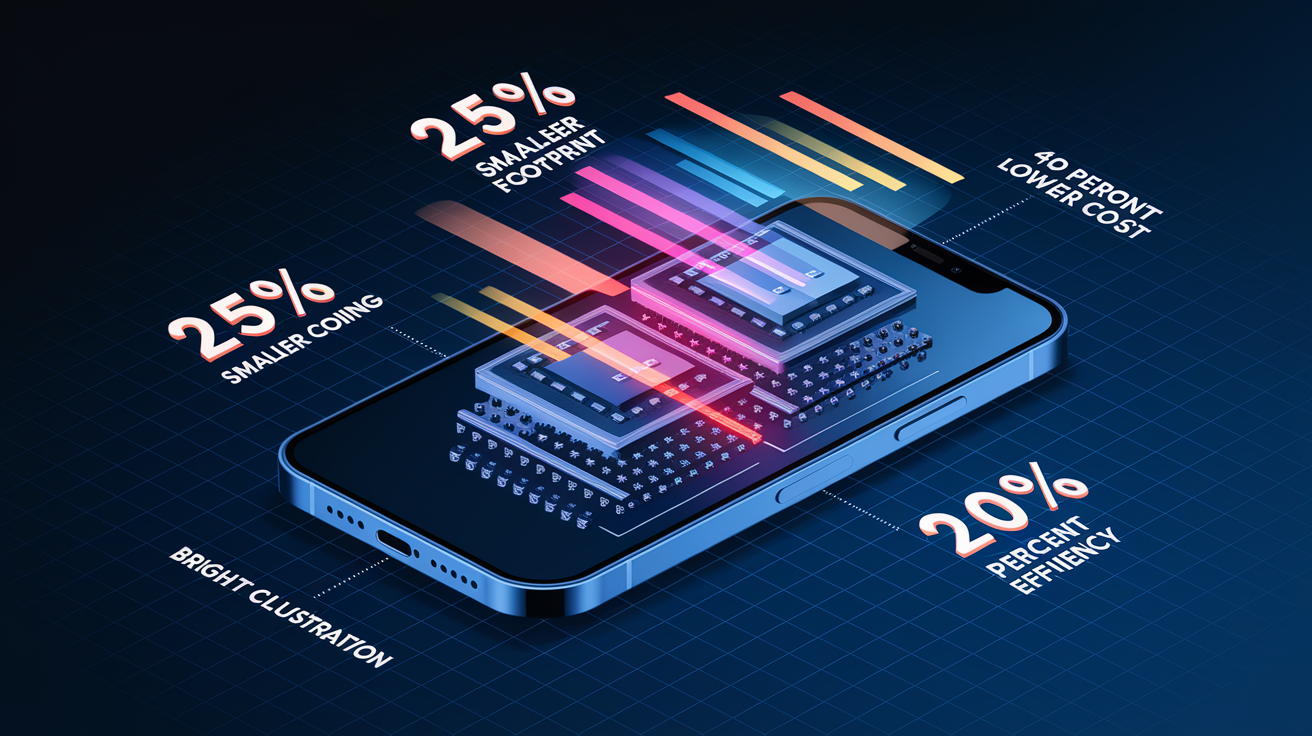
The X75 introduced Qualcomm’s first converged mmWave and sub-6 GHz transceiver, merging two previously separate radio chains into a unified architecture. This integration reduces the modem’s board footprint by 25%, freeing space inside smartphones for larger batteries, additional cameras, or enhanced cooling systems. Manufacturing costs drop by up to 40% compared with dual-transceiver designs, a savings that can trickle down to lower device prices or improved component budgets elsewhere in the phone.
Converged architecture also improves RF front-end coordination. A single transceiver can dynamically allocate resources between mmWave and sub-6 tasks, balancing power and thermal load more efficiently than isolated modules. When a device switches from sub-6 to mmWave—moving from outdoor macro coverage into a dense urban mmWave zone—the unified transceiver executes the handoff faster and with less signaling overhead, maintaining session continuity and reducing latency spikes.
AI-based antenna tuning adapts to real-world device handling. Phones change RF characteristics based on how you hold them, whether they’re in a pocket, on a desk, or mounted in a car. The modem’s ML models measure impedance mismatches and adjust matching networks in real time, compensating for hand grip, case materials, and nearby metal objects. This dynamic calibration recovers several decibels of signal strength that would otherwise be lost, improving throughput and coverage without requiring you to change how you hold your device.
Four key architectural benefits:
- 25% smaller modem footprint enables thinner device designs or additional internal components like bigger batteries
- 40% lower manufacturing cost for the converged transceiver compared with separate mmWave and sub-6 modules
- Up to 20% transceiver power efficiency improvement through unified resource management and smarter thermal distribution
- Real-time antenna impedance tuning that recovers signal loss caused by hand placement, cases, and environmental obstacles
Snapdragon X Gen Modem Comparisons: X65 vs X70 vs X75 vs X105

The X65, introduced in 2021, established Qualcomm’s multi-gigabit flagship modem class with up to 10 Gbps theoretical downlink, mmWave and sub-6 support, and advanced carrier aggregation. It set the baseline for high-performance Android devices but relied on traditional, non-AI radio management. Signal processing followed fixed algorithms with limited real-time adaptation.
The X70 arrived in 2022, adding on-device AI for the first time. Software-based machine learning improved signal processing, channel estimation, and beam management, delivering better cell-edge throughput and more reliable connections in challenging RF environments. This generation bridged the gap between brute-force speed and intelligent connectivity, but AI models ran on general-purpose DSP resources rather than dedicated hardware, limiting performance headroom.
The X75, announced in 2024, brought hardware acceleration via a dedicated tensor accelerator, achieving 2.5× AI performance over the X70. It also introduced the converged mmWave and sub-6 transceiver, 10-carrier mmWave aggregation, 5× sub-6 aggregation, and FDD uplink MIMO. These improvements reduced power consumption, shrank the modem footprint, and enhanced spectral efficiency. The X75 is the first modem built explicitly for 5G Advanced (Rel-18), positioning it for future network upgrades that unlock additional features as carriers implement the standard.
The X105, unveiled in 2026 and expected in devices through 2027, focuses on agentic AI—on-device and network-aware agents that require ultra-reliable, low-latency connectivity. It adds integrated NR-NTN (5G over satellite) for voice, data, and video in remote or backup scenarios, cuts RF power by approximately 30%, and shrinks the physical package by another 15%. Predictive sensing software layers optimize connectivity proactively, anticipating conditions before they degrade. The X105 represents the convergence of AI-first design, satellite fallback, and extreme power efficiency.
| Modem | Key Features | Real-World Benefit |
|---|---|---|
| X65 (2021) | Up to 10 Gbps DL, mmWave + sub-6, multi-carrier aggregation, no AI | Established multi-gig speeds; limited adaptive optimization in dynamic environments |
| X70 (2022) | On-device AI (software), improved signal processing, same peak rates as X65 | Better cell-edge performance and beam management; AI runs on general DSP, not dedicated hardware |
| X75 (2024) | Hardware tensor accelerator (2.5× AI perf), converged transceiver, 10× mmWave / 5× sub-6 aggregation, 5G Advanced (Rel-18) support | Faster, more consistent throughput; 25% smaller footprint, 20% lower transceiver power; smarter handovers and indoor coverage |
| X105 (2026) | Agentic AI focus, integrated NR-NTN (satellite), ~30% RF power cut, 15% smaller package, predictive sensing | Ultra-reliable connectivity for AI agents; global satellite fallback for voice/data/video; significant battery savings and design flexibility |
Device and OEM Adoption of Snapdragon X Gen Modems

Snapdragon X-series modems power flagship Android smartphones from major global OEMs. Samsung historically integrates Qualcomm modems in Galaxy S and Note series devices sold in regions where mmWave and broad carrier aggregation matter—primarily North America and parts of Asia. Xiaomi, OnePlus, OPPO, Vivo, Motorola, and Honor deploy X-series modems across their premium lineups, relying on Qualcomm’s proven RF front-end co-design and global band support to simplify device variants and accelerate time to market.
The X75 began sampling to hardware partners with first devices expected to ship in the second half of 2023. Full benefits depend on carrier adoption of 5G Advanced (Rel-18) features, which phase in over subsequent years as networks upgrade infrastructure. The X105 is slated for devices launching in 2026 and into 2027, targeting the next wave of flagship phones built around agentic AI workloads and satellite connectivity. Timing varies by OEM release cycles. Early adopters typically ship new modems in spring or fall flagship launches.
Common OEM adopters:
- Samsung (Galaxy S and Note series in select regions, though Exynos variants exist for some markets)
- Xiaomi (Mi, Redmi K series flagships)
- OnePlus (numbered flagship series)
- OPPO (Find X series)
- Vivo (X series premium models)
Use-Case Scenarios Showing Snapdragon X Gen Modem Advantages

Cloud gaming benefits directly from lower, more consistent latency. Snapdragon X Gen modems reduce over-the-air ping times and eliminate latency spikes during handovers or congestion, keeping input lag below perceptible thresholds even when streaming AAA games from remote servers. AI-driven beam management and predictive handoff logic maintain stable connections during movement. Playing on a train or in a car, where older modems would stutter or disconnect.
AR and VR applications demand tight latency budgets and high sustained throughput for real-time rendering and sensor fusion. The X75’s sub-10 ms latency capability (in well-provisioned SA networks) combined with multi-gigabit download speeds lets cloud-rendered AR overlays and VR experiences react instantly to head movement and environmental changes. Reduced motion-to-photon latency minimizes nausea and improves immersion, making mobile AR/VR practical for extended sessions.
Remote work and video conferencing improve in coverage-challenged environments. Better indoor penetration, AI-based interference mitigation, and FDD uplink MIMO boost upload quality for video calls, screen sharing, and file uploads from home offices, co-working spaces, and hotel rooms. Fewer dropped packets mean clearer audio, smoother video, and less frustration during critical client calls or team meetings.
Six scenarios where modem advantages are most visible:
- Cloud gaming on mobile devices during commutes or travel, with stable low-latency connections even at high speeds
- 4K and 8K video streaming with faster start times, fewer buffering pauses, and seamless adaptive bitrate switching
- AR/VR experiences requiring real-time responsiveness and high bandwidth for cloud rendering and sensor data
- Enterprise low-latency connectivity for remote diagnostics, telemedicine, and industrial IoT applications
- Indoor crowded environments like stadiums, airports, and conference centers where AI-based resource management prevents congestion slowdowns
- Fixed wireless access and private 5G deployments in areas with limited wired broadband, leveraging multi-carrier aggregation and improved spectral efficiency for higher sustained throughput
Final Words
You’ll notice the changes in daily use: faster downloads, smoother streaming, and lower lag for cloud gaming and live video.
This article showed how 10-carrier mmWave and 5× sub-6 aggregation, on-modem AI, improved RF design, and power gains translate to real benefits, plus how X75 and X105 compare and where phones are shipping.
Bottom line: Snapdragon X Gen modem advantages for 5G phones mean more consistent speeds, better indoor coverage, and lower latency, so newer devices will feel snappier and more reliable.
FAQ
Q: Which Snapdragon processor is best for 5G?
A: The Snapdragon processors paired with the newest X-series modems—especially devices using the X75 (first for 5G Advanced) or the upcoming X105—are best for 5G, offering higher speeds, aggregation, and AI-driven reliability.
Q: Are 5G modems worth it?
A: 5G modems are worth it if you need faster downloads, lower latency, and steadier connections while moving or in crowded places; users who stay mostly on Wi‑Fi will notice less everyday difference.
Q: What are some of the benefits of the Snapdragon X series processors for mobile professionals?
A: The Snapdragon X-series modems give mobile professionals faster upload/downloads, lower latency for cloud apps and meetings, better indoor and roaming coverage, AI-managed connection stability, and more consistent performance in crowded networks.
Q: Does 5G need a modem?
A: 5G requires a modem to talk to cellular networks; that modem can be a separate chip or integrated into the phone’s SoC and handles radio layers, carrier aggregation, and connection management.