


Sony split its camera sensor into two silicon layers — and that matters more than marketing copy suggests.
The Xperia 1 V’s Exmor T stacks a light‑catching photodiode layer over a separate transistor layer, connected by tiny vertical connectors.
That separation lets every pixel collect more photons, amplifies charge at the pixel to cut read noise, and enables faster readout for 4K/120fps and steadier autofocus.
This post breaks down the engineering, the pixel‑binning that produces 12MP images, and what those choices mean for real photos and video.
Complete Engineering Breakdown of Sony’s Exmor T Dual‑Layer Sensor Architecture

Sony’s Exmor T sensor is the first stacked CMOS design in the Xperia 1 line to physically split the photodiode and transistor across two separate silicon layers. Traditional single-layer designs cram both the light-sensitive photodiode and the pixel transistor onto the same plane, forcing a constant trade between photodiode area and transistor routing space. Exmor T puts the photodiode on top, closest to incoming light in a backside-illuminated setup, while pixel amplification and readout transistors live on a separate wafer below. The two layers connect through through-silicon vias. This separation ends the geometric tug of war: the entire pixel surface can collect photons while the transistor layer handles charge conversion without blocking light or shrinking fill factor.
Amplification happens right at the pixel before any charge moves. Each pixel gets its own amplifier on the lower transistor layer, converting photoelectron charge into a voltage immediately instead of waiting until the signal reaches a column amplifier farther down the line. The upshot? Lower read noise (random variation introduced during readout) and a higher signal-to-noise ratio, especially when photon counts are small, like in dim rooms or fast exposures. Amplifying closer to the source keeps weak signals distinguishable from the electronic noise floor, which boosts low-light sensitivity. Sony says this design delivers roughly 2× better low-light performance than the Xperia 1 IV, whose single-layer sensor squeezed transistors next to photodiodes.
Quantum efficiency (the percentage of incoming photons that actually turn into electrons) goes up when nothing sits on top of the photodiode. The Exmor T photodiode layer uses a backside-illuminated structure, so light hits the silicon from the back and skips the metal wiring entirely. Combine that with zero transistor overlap, and the sensor captures a bigger slice of incoming light across the visible spectrum. Translation: brighter midtones, cleaner shadows, wider dynamic range in high-contrast scenes. The stacked design also cuts the distance signals travel from photodiode to amplifier, reducing parasitic capacitance and the signal loss that comes with it.
The readout circuitry on the transistor layer can run faster because it’s no longer fighting for space with the sensitive photodiode array. Faster readout means:
- Continuous shooting at 30 fps with full autofocus and auto-exposure tracking on every frame
- 4K video at up to 120 fps across all main lenses without the rolling-shutter wobble slower sensors suffer from
- Multi-frame overlay capture and computational noise pipelines that need rapid bursts
- Lower latency for real-time subject tracking and phase-detection autofocus updates
- Parallel pixel-row processing, letting the sensor grab simultaneous HDR exposures before the scene shifts
The 52-megapixel total resolution includes 48 megapixels of active imaging area, with the rest reserved for stabilization crop margins. Sony bins this 48-megapixel array down to 12-megapixel output by default: four neighboring pixels combine into one, averaging their signals to crush random noise and expand dynamic range. The 1/1.35-inch physical sensor size is about 1.7× larger in area than the Xperia 1 IV’s sensor, giving you bigger individual pixel pitch even after you account for the higher megapixel count before binning.
Manufacturing Workflow and Layer Integration of Sony’s Exmor T Sensor

Building a dual-layer transistor pixel sensor means running two separate semiconductor fabrication processes. The photodiode wafer starts on a silicon substrate tuned for photon absorption, usually lightly doped silicon with minimal defects to maximize quantum efficiency. Engineers pattern the photodiode array, microlenses, and color filter array on this wafer, then thin the substrate from the backside so light travels the shortest distance to the active silicon. The transistor wafer follows a different recipe: high-density CMOS logic fabrication to build pixel amplifiers, column ADCs, timing circuits, and readout buffers. These transistors run at higher voltages and switching speeds than the delicate photodiodes, so keeping them on a separate layer prevents electrical interference and thermal crosstalk.
After both wafers pass inspection, bonding machines align them with sub-micron precision. Through-silicon vias (vertical copper or tungsten interconnects etched through one or both wafers) electrically link each photodiode to its matching amplifier on the layer below. The bonding process uses either oxide-oxide fusion (heating the wafers under pressure until their oxide surfaces chemically bond) or hybrid copper-oxide bonding (copper pads on each wafer physically connect while oxide surrounds them for mechanical strength). Post-bonding, the stack gets additional metallization steps to add the final wiring layers connecting pixel columns to the image signal processor and memory controllers.
| Layer | Role | Manufacturing Challenge |
|---|---|---|
| Photodiode wafer | Converts incoming photons to electron charge; includes microlens and color filter | Backside thinning without introducing defects; keeping quantum efficiency high across wavelengths |
| Transistor wafer | Amplifies per-pixel charge, handles analog-to-digital conversion, manages readout timing | High-density CMOS logic while keeping power and heat down; precise via alignment for every pixel |
| Interconnect wiring stack | Routes signals from pixel array to ISP; supplies power and clock signals | Through-silicon via fabrication without damaging photodiodes; maintaining signal integrity across layers |
How Pixel Size, Pixel Binning, and Sensor Size Shape Xperia 1 V Image Output

The Xperia 1 V sensor spits out only 12-megapixel images despite its 48-megapixel active array. High-resolution capture isn’t an option. Sony’s pixel-binning algorithm clusters four neighboring same-color pixels (a 2×2 Bayer quad) into one output pixel, adding up their photoelectron counts before analog-to-digital conversion. This summation bumps up the effective full-well capacity (the max charge a pixel can hold before clipping) and averages out read noise, improving signal-to-noise ratio by roughly 2× in theory, assuming read noise is the main culprit. Photon shot noise (the statistical randomness in photon arrival) still hangs around, but the sensor’s larger photodiode area per binned pixel grabs more photons in the same exposure time, nudging shot noise into a better part of the exposure curve.
The 1/1.35-inch sensor diagonal measures about 9.6 mm. The Xperia 1 IV used a sensor around 1/1.7 inch (roughly 7.6 mm diagonal), making the 1 V’s sensor about 1.7× bigger in surface area. Larger sensors scoop up more total light for a given scene brightness and focal length, cutting down the ISO boost needed to nail correct exposure. Lower ISO means less amplification of baseline read noise and dark current, so cleaner images. The Xperia 1 V sets aside roughly 20% of the sensor’s perimeter pixels for image-stabilization crop, letting the phone digitally shift the active readout window to cancel hand shake without black borders creeping in. This crop shrinks the effective field of view slightly but keeps resolution intact.
The binning pipeline works like this:
- Four adjacent photodiodes (same Bayer color filter—red, green, or blue) collect charge during exposure
- Each photodiode’s dedicated transistor amplifies its charge independently on the lower silicon layer
- The sensor’s analog summation circuit combines the four amplified signals before the column-level analog-to-digital converter
- A single 12-megapixel pixel value emerges, with about double the signal amplitude and quadruple the charge capacity of a non-binned pixel
Since the camera never saves the native 48-megapixel data, you can’t pull finer detail in good light when resolution would beat noise. Competitors offering switchable high-resolution modes let photographers pick between low-light clarity (binned) and maximum detail (full resolution). The Xperia 1 V doesn’t give you that choice.
Xperia 1 V Main‑Camera Lens Pairing and Field‑of‑View Behavior

The main camera pairs the 1/1.35-inch Exmor T sensor with a 24 mm equivalent focal length lens at f/1.9 maximum aperture. Sony dialed back the aperture from f/1.7 in the Xperia 1 IV, probably a compromise to handle the larger sensor’s image circle requirements and keep the phone profile slim. The physical focal length (actual lens-to-sensor distance, not the 35 mm equivalent marketing figure) sits around 5 to 6 mm given the sensor size, requiring aspherical lens elements to fix field curvature and coma across the frame. ZEISS T* anti-reflective coating on all air-to-glass surfaces cuts down internal reflections and flare, especially important when shooting toward light sources or in high-contrast scenes where stray light can wash out shadows or spawn ghost images.
The 48-megapixel active area plus the stabilization crop gives you an effective field of view slightly narrower than the lens’s geometric projection. When the phone applies digital stabilization in video mode or burst shooting, it continuously picks a centered 12-megapixel window from the available sensor area, shifting that window frame by frame to fight motion. In stills, the crop is pre-applied, so the saved 12-megapixel image already accounts for the reserved margin. The f/1.9 aperture lets in roughly 1.3× less light than f/1.7 (calculated as the square of the ratio: (1.9/1.7)² ≈ 1.25), meaning the sensor has to make up the difference with either higher ISO or longer exposure time to match the previous model’s exposure at the same scene brightness. The bigger sensor area offsets this cut, delivering a net bump in signal-to-noise ratio despite the smaller aperture.
Telephoto and Ultra‑Wide Sensor Technologies in the Xperia 1 V

The telephoto module uses a 12-megapixel sensor paired with a variable-aperture periscope-style lens covering 85 mm to 125 mm equivalent focal lengths, toggling between f/2.3 at the wide end and f/2.8 at full extension. Phase-detection autofocus pixels sit on-sensor, and optical image stabilization fights handshake, critical at longer focal lengths where tiny angular shifts translate to big image jumps. Independent testers say image quality stays decent at 85 mm but falls apart noticeably at 125 mm, with fine detail looking smudged and edges losing contrast. Sony carried the telephoto hardware over unchanged from the Xperia 1 IV, so the optical performance ceiling sticks around. The variable aperture adjusts via a mechanical iris inside the lens assembly, tuning depth of field and diffraction trade-offs across the zoom range, though the modest sensor size limits background blur compared to larger-sensor cameras at the same framing.
The ultra-wide camera pairs a 12-megapixel sensor with a 16 mm equivalent f/2.2 lens. Phase-detection autofocus coverage means the ultra-wide can lock focus quickly even at close distances, a step up from older fixed-focus ultra-wide setups. The lens uses multiple aspherical elements to control distortion. Most ultra-wide smartphone lenses show 2 to 4% barrel distortion at the frame edges, corrected in post by warping the image geometry. The Xperia 1 V applies this correction before saving the JPEG, straightening lines near frame borders but costing a bit of resolution in the corners due to pixel interpolation. Color and exposure matching across all three rear cameras leans on per-lens calibration data stored in the phone’s firmware, letting you switch lenses seamlessly in video or use digital zoom ranges that span multiple modules.
Key telephoto and ultra-wide notes:
- Telephoto delivers sharp results at 85 mm; skip 125 mm for detail-critical work. Software upscaling from 85 mm often gets you the same or better results.
- Ultra-wide keeps color consistent with the main camera but shows visible corner softness, typical of compact wide-angle smartphone optics.
- Both modules support real-time subject tracking and eye autofocus, though tracking reliability drops at longer telephoto focal lengths when the subject shrinks in frame.
Autofocus and Real‑Time Tracking Powered by Xperia 1 V Sensor Design

Phase-detection autofocus pixels are sprinkled across the Exmor T sensor array, typically one out of every ten to twenty pixels swapping its color filter for a directional mask that splits incoming light into left and right paths. The sensor compares intensity between these split signals: when the image is in focus, both halves match. When defocused, one side gets more light than the other, and the direction and size of the mismatch tell the lens motor which way to move and how far. Since PDAF pixels sit directly on the image sensor instead of needing a separate AF module, the system measures focus across the entire frame at once, locking onto off-center subjects or low-contrast scenes fast and accurately.
Real-time Eye AF and Real-time Tracking borrow code from Sony’s Alpha mirrorless camera line. The phone’s image signal processor runs a lightweight convolutional neural network that spots human faces, finds eyes within those faces, and estimates the three-dimensional position of each detected subject. The network refreshes these predictions at the sensor’s readout rate (up to 30 times per second during continuous shooting), letting the AF system anticipate subject motion and adjust focus ahead of time instead of playing catch-up. AI depth analysis supplements the PDAF data by estimating distance to objects across the scene, helping the tracking algorithm tell a subject apart from a visually similar background and hold lock during partial occlusions or fast movement.
| AF Feature | Description |
|---|---|
| Phase-Detection Autofocus (PDAF) | Dual-photodiode pixels measure focus error direction and size; locks focus in one shot without hunting |
| Real-time Eye AF | Neural-network face and eye detection runs continuously; prioritizes nearest or selected eye for portrait shooting |
| Real-time Tracking | Subject-detection algorithm keeps focus on a moving target across the frame; works with humans, animals, and high-contrast objects |
| High-Speed Continuous AF/AE | Recalculates focus and exposure for every frame during 30 fps burst shooting; no blackout between frames |
Dynamic Range, Noise Reduction, and Xperia 1 V Computational Pipeline
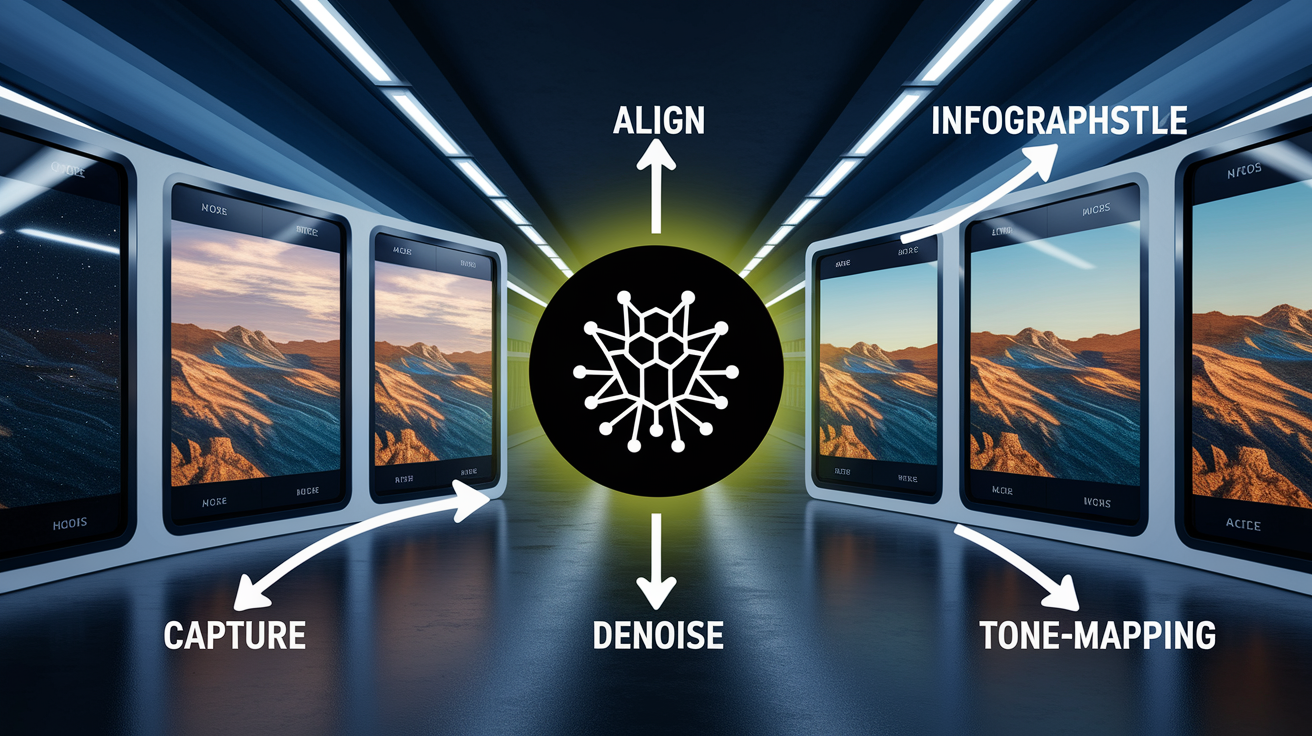
Sony’s multi-frame overlay processing grabs a quick burst of exposures (typically three to eight frames depending on scene motion and how much time the processor has) and lines them up with sub-pixel accuracy before averaging the results. Photon shot noise (the main noise source in well-exposed images) jumps around randomly frame to frame, so averaging multiple frames cuts this noise by a factor proportional to the square root of the frame count. Eight frames get you roughly 2.8× noise reduction compared to a single exposure. The Exmor T sensor’s high-speed readout lets these frames fire off in quick succession, keeping motion blur from hand shake or subject movement to a minimum so frames stay aligned and ghosting stays out.
AI denoising kicks in after the multi-frame merge. A neural network trained on millions of noisy/clean image pairs guesses the underlying clean signal from the noisy merged image. This network runs on the phone’s dedicated neural-processing unit (part of the Snapdragon 8 Gen 2 SoC) and can tell photographic detail (fine texture, edges) apart from noise (random high-frequency junk), selectively smoothing the latter while keeping the former sharp. The sensor’s per-pixel amplification on the transistor layer hands off a cleaner baseline signal with lower read noise, which lightens the load on the AI model. Less severe noise is easier to strip out without creating that waxy, over-smoothed look common in heavy-handed computational pipelines.
Sony says the combined hardware and software stack hits dynamic range “equivalent to a full-frame camera,” comparing the Xperia 1 V’s output to its own Alpha-series 35 mm sensors. This claim leans on specific test conditions, likely a controlled scene with known luminance ratios, processed through the phone’s HDR merge stack. Read it as “the phone can render a comparable tonal range in processed JPEGs” instead of “the sensor’s raw dynamic range matches a full-frame chip,” since the physical sensor well depth and read noise floor still cap single-exposure performance.
The noise-reduction workflow goes in three stages:
- Capture burst of 3 to 8 frames at slightly offset exposures (sometimes including a longer exposure for shadow detail)
- Align frames using optical-flow motion estimation; toss or mask regions with big inter-frame changes (moving subjects, blinking lights)
- Merge aligned frames via weighted average, then run neural-network denoising on the merged result, followed by tone mapping and color grading
Xperia 1 V Video Sensor Modes and High‑Speed Readout Capabilities

The Exmor T sensor supports 4K (3840 × 2160 pixel) video recording at up to 120 fps on all three rear cameras: main, ultra-wide, and telephoto. The stacked CMOS architecture’s parallel readout paths let each pixel row be read while the next row is still soaking up light, a trick called rolling-shutter readout with overlapping exposure. At 120 fps, each frame’s exposure time tops out at roughly 8.3 milliseconds (1/120 second), and the sensor has to read all rows, hand data to the ISP, and reset for the next frame inside that window. Traditional single-layer sensors often choke at the analog-to-digital converter or struggle with power dissipation when reading this fast. The Exmor T’s dedicated transistor layer spreads heat across two silicon planes and places column ADCs physically closer to pixel amplifiers, cutting parasitic capacitance and cranking up clock rates.
Sony’s Cinema Pro and Videography Pro apps expose manual control over resolution, frame rate, shutter speed, ISO, white balance, and focus. Cinema Pro borrows its interface from Sony’s cinema camera line, showing timecode, waveform monitors, and zebra-stripe overexposure warnings. Videography Pro targets live-streamers and vloggers, weaving in real-time comment overlays and one-tap streaming to platforms. Both apps keep real-time subject tracking running during recording. The AF system refreshes focus at the video frame rate (up to 120 times per second) without visible focus breathing or hunting, a trick enabled by the sensor’s continuous PDAF readout and predictive tracking algorithms.
The lack of 8K video reflects a practical trade-off. 8K (7680 × 4320 pixels) would need roughly 33 megapixels read out at 24 to 30 fps, pushing thermal limits and demanding a bigger battery or active cooling. Sony picked high frame rates at 4K (useful for slow-motion capture and smoother motion) over the higher resolution that few users need or can display right now. The 120 fps 4K mode lets you play back at 5× slow-motion when the footage drops to a 24 fps timeline, with all frames captured optically instead of interpolated.
| Resolution | Max FPS | Lens Support |
|---|---|---|
| 4K (3840 × 2160) | 120 / 60 / 30 / 25 / 24 | Main, ultra-wide, telephoto |
| Full HD (1920 × 1080) | 120 / 60 / 30 / 25 / 24 | Main, ultra-wide, telephoto |
| 8K | Not supported | — |
Xperia 1 V Color Science, White Balance, and S‑Cinetone Integration

S-Cinetone is a color-grading profile Sony built for its FX cinema cameras, designed to render skin tones with natural warmth and smooth highlight roll-off without needing manual LUT application in post. The Xperia 1 V runs a mobile version of this profile, applying a non-linear tone curve that compresses highlights gradually (keeping detail in bright spots like sky or light sources) while holding mid-tone contrast for faces and textures. The profile dials back color saturation a bit in the shadows and shifts the hue of common skin-tone ranges (yellow, orange, red) toward a warmer, less magenta-tinted look. When shooting video with S-Cinetone active, the phone embeds the tone curve into the recorded file, so footage looks consistent across playback devices without extra color correction.
AI white balance scans the scene in real time, spotting likely light sources (sunlight, tungsten bulbs, fluorescent fixtures, mixed lighting) and applying per-channel gain tweaks to kill color casts. The algorithm uses a neural network trained on thousands of labeled scenes to tell intentional color (a sunset, a neon sign) apart from accidental color casts (indoor tungsten turning everything orange). This training cuts down the common smartphone white-balance mistake where the camera overcorrects a warm scene, flipping a cozy interior into a cold, blue-tinted shot. The ZEISS T* coatings on the lens elements help this system stay accurate by reducing lens flare and internal reflections that can shift the average color of light hitting the sensor, especially when shooting into the sun or under mixed lighting with strong highlights.
Creative Look presets offer six predefined color and contrast profiles, each adjustable along two axes: one controlling overall contrast or clarity, the other tweaking color intensity or warmth. The presets are:
- ST (Standard): neutral color and contrast; closest to raw sensor data
- VV (Vivid): boosted saturation and contrast for punchy landscapes and high-energy scenes
- FL (Sunset): warm color shift emphasizing reds and oranges; pulls back blues
- IN (Black & White): monochrome with adjustable contrast and grain texture
- SH (Soft): reduced contrast and saturation for dreamy, low-key portraits
- BW (High Contrast B&W): monochrome with expanded tonal range and deep blacks
Comparison of Xperia 1 V Sensor to Xperia 1 IV and Competing Flagships
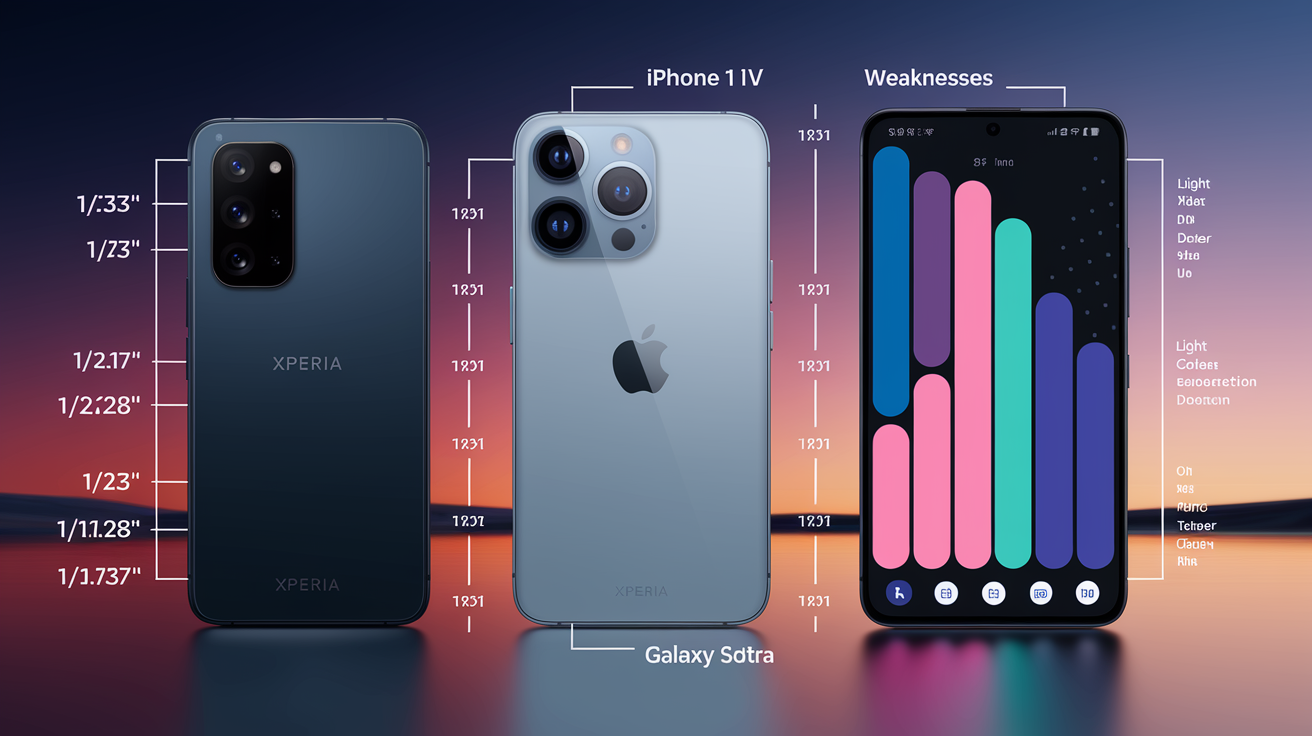
Jumping from the Xperia 1 IV’s roughly 1/1.7-inch sensor to the 1 V’s 1/1.35-inch chip is about a 1.7× increase in light-collecting area. Sony says this bigger sensor, combined with the dual-layer transistor pixel architecture and upgraded noise-reduction algorithms, delivers 2× better low-light performance than the previous model. Independent reviewers confirm a real bump in shadow detail and less chroma noise when shooting at ISO 1600 and above, though the gap to class leaders like the iPhone 14 Pro and Samsung Galaxy S23 Ultra still shows up in side-by-side comparisons. Those devices use larger sensors (1/1.28-inch and 1/1.33-inch respectively for their main cameras) and more aggressive multi-frame HDR stacking, often cranking out brighter, cleaner night shots with less visible grain.
Sony deliberately picked the 1/1.35-inch sensor over bigger options (like the 1-inch IMX sensors used in some compact cameras and concept phones) to keep the Xperia 1 V at 187 grams and 8.3 mm thickness. A 1-inch sensor would need a proportionally bigger lens to cover the image circle, adding weight and camera-bump protrusion. Sony bet on the slim, balanced form factor of its 21:9 design over ultimate sensor size, figuring the Exmor T’s dual-layer pixel and computational pipeline would close the performance gap without the ergonomic hit. In practice, this trade works well for daylight and moderate indoor lighting but leaves the phone trailing competitors in extreme low-light scenarios where raw photon count and sensor well depth matter most.
The telephoto module stays unchanged from the Xperia 1 IV, so the well-documented softness at 125 mm sticks around. Competing flagships with newer periscope designs (Samsung’s 10× optical module, for instance) deliver sharper results at equivalent focal lengths, though Sony’s 85 mm performance holds up. The ultra-wide camera matches or slightly beats the 1 IV in color accuracy and distortion control, thanks to better lens coatings and refined calibration, but still trails the best ultra-wide setups from Apple and Google in corner sharpness and low-light noise.
| Device | Sensor Size (Main) | Strengths | Weaknesses |
|---|---|---|---|
| Xperia 1 V | 1/1.35″ (Exmor T dual-layer) | Best manual control suite; strong video AF tracking; improved low-light vs previous Xperia; S-Cinetone color | Telephoto soft beyond 85 mm; no high-res mode; shorter update support; low-light trails top competitors |
| Xperia 1 IV | ~1/1.7″ (single-layer CMOS) | Established manual app ecosystem; similar telephoto and ultra-wide optics | Smaller sensor; single-layer pixel limits low-light; lower burst rate (20 fps vs 30 fps) |
| iPhone 14 Pro | 1/1.28″ (Apple quad-pixel) | Better low-light noise control; class-leading HDR and computational pipeline; 48 MP high-res option | Limited manual control; no pro video apps; smaller telephoto range (3× optical) |
| Samsung Galaxy S23 Ultra | 1/1.33″ (200 MP binned to 12.5 MP or 50 MP) | 10× periscope telephoto; flexible resolution modes; brightest low-light output; longest zoom reach | Heavier (234 g) and thicker; aggressive computational processing can over-sharpen; color science more saturated |
Final Words
The Exmor T’s stacked, dual-layer layout is the headline: it separates photodiodes and transistors, boosts light capture, cuts read noise, and enables faster readout for 30 fps bursts and 4K/120 recording.
We ran through manufacturing and layer bonding, pixel binning and sensor-size tradeoffs, lens pairing and FOV behavior, tele/ultrawide modules, AF/tracking logic, and the computational pipeline that ties it all together.
Sony Xperia 1 V camera sensor tech explained shows a sensible, engineering-forward step—better low-light performance and video speed without big size or weight compromises. Worth watching.
FAQ
Q: Does a bigger sensor mean better quality?
A: A bigger sensor generally means better image quality because it captures more light, improving low‑light performance and dynamic range; lens, pixel design, and processing matter. Xperia 1 V’s Exmor T is 1/1.35″ (~1.7× larger) and Sony claims 2× low‑light sensitivity.
Q: Which is better Sony IMX or Lyt?
A: The better choice between Sony IMX and Lyt depends on the specific sensor model, pixel size, stacking, and ISP tuning; Sony’s Exmor T stacked design improves light efficiency, readout speed, and noise, but compare specs case‑by‑case.
Q: What is the camera specification of Sony Xperia 1 V?
A: The camera specifications of the Sony Xperia 1 V include a 52MP (48MP effective) Exmor T 1/1.35″ main sensor (24mm f/1.9, bins to 12MP), 12MP tele 85–125mm f/2.3–2.8, 12MP 16mm f/2.2 ultra‑wide, ZEISS T*, OIS, PDAF, and 4K at 120fps.
Q: What are some common problems with the Xperia 1?
A: Common problems with the Xperia 1 include softer detail at 125mm telephoto, no native 48MP output (sensor bins to 12MP), a ~20% stabilization crop reducing field‑of‑view, and rivals sometimes outperforming it in low‑light and zoom.